
The relatively high prevalence of an intellectual disability and its variability induce active research of the etiology of this disorder. Upon the observation that it occurs with 20% higher frequency in males than females [1] extensive studies of X chromosome-linked disorders affecting intelligence are held. 145 genes in X chromosome are currently known to be linked with intellectual disability and it comprises 17,12% of all coding sequences in X chromosome, in comparison with 5,43% on average in autosomes. [2]
We were presented with two male brothers (patient A, a 12-year-old boy and patient B, an 8-year-old boy). Both patients were cognitively and motorically delayed. Patient A was unable to construct sentences and started to walk at the age of 4,5, in addition, he experienced stereotypical arm movements. Patient B at the age of 8 was evaluated to produce speech, typical for 15-16-month-old children, he started to walk at the age of 4 and presents grimacing smiling. Both patients experience seizures and intellectual disability of an unknown cause. Based on the genealogical analysis, we predicted that the inheritance pattern of the mutation is X-linked because of the mild presentation in mother (reported seizures in childhood and marginal intelligence) and unconfirmed family history of mother's brother having seizures, developmental delay and death at the age of 9. Our aim was to analyze whole exome sequencing (WES) data of two sibs and their parents using in silico methods in order to find potential intellectual disability causing genes and to create a further investigation plan for confirmation of the causal pathogenic variant.
Samples for WES were taken from both sibs and their parents. In total, 3974 pathogenic variants were automatically annotated and filtered according to their frequency in the population (MAF<2%). Therefore, 6 pathogenic variants in X chromosome common for both sibs, and the mother but not found in the genome of the healthy father, were used for further investigation. They were analyzed using Sift, PolyPhen, Mutation Taster (MutT) and Human Splicing Finder (HSF) software. For further description, ExAC, 1000G and HGMD databases were used. According to the analysis, it was concluded that two genes, ARHGEF6 and SLC9A6, are associated with intellectual disability. ARHGEF6 mutation appeared to be a variant of unknown significance and it is usually associated with non-syndromic intellectual disability. Another candidate gene, SLC9A6, mutation was likely to be a pathogenic splice donor variant. This gene is associated with Christianson syndrome, which frequency in the population is <1/1 000 000. Clinical presentation of this syndrome involves intellectual disability, seizures, absent speech and stereotypical movements [3] which strongly fits the clinical presentation of our patients. Furthermore, SLC9A6 pathogenic variant carriers are often presented with milder symptoms. [4]
Our investigated SLC9A6 pathogenic variant was not previously described in literature. Therefore, it was decided to model this mutation and analyze its theoretical significance. Fig. 1 depicts 3D models of a Na/H antiporter 6, an SLC9A6 gene product, with and without the mutation. Both models were created using Phyre 2 software.
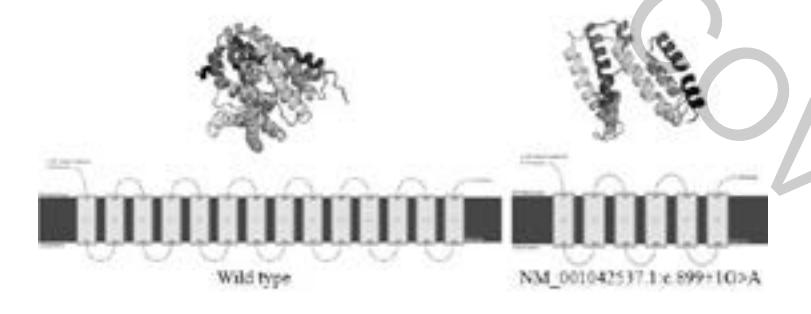
It was concluded that the identified SLC9A6 pathogenic variant is fitting our patients' clinical presentation and is altering the gene product significantly and sufficiently to induce symptoms. For the confirmation of this mutation causing altered splicing, it is planned to perform in vitro analysis of the SLC9A6 mRNA/cDNA.