Reactive Magnetron Sputtering (RMS) is a Physical Vapor Deposition (PVD) technology used widely in both scientific investigation and commercial coating production. The RMS processes without appropriate process control can be accompanied by problems, such as uncontrolled transition to a fully poisoned target state (with a significant drop in deposition rate), process drift, arcing, poor run-to-run repeatability. Those are main limiting factors to use RMS technology in deposition of high quality optical coatings for precise laser optics.
Previously, in our laboratory RMS of metallic Hf, Zr, Nb and Sc targets, showed unique possibilities to control deposition process by combined different feed-back signals, leading high refractive index and low loss HfO2, ZrO2, Nb2O5 and Sc2O3 film deposition, suitable for laser optics application [1].
Oxynitrides are materials with yet unexplored physical and functional properties with great potential for industrial applications [2]. With one metal target in various gas mixture it is possible effectively control oxynitride film composition and properties. In optical applications, oxynitride materials might be used, for example, as selective absorber, for antireflective coating for solar cells, rugate, edge filters and sensors.
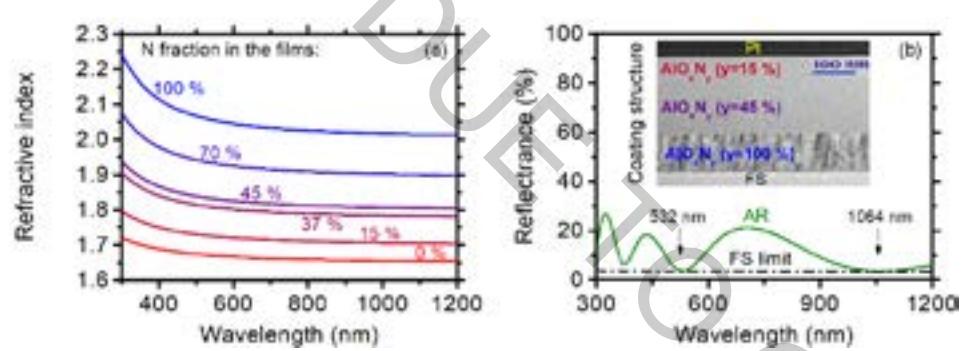
In this research [3], investigation of aluminum oxynitride films deposition using one metallic target in various gas mixtures was done. The optimized preparation conditions for such RMS process were found. Non-optimized conditions led to sputtering target poisoning or under stoichiometric films formation. Dependence between gas composition and changes of nitrogen concentration in the film and their properties was investigated. The possibility of using oxynitride films for antireflective coatings (AR) deposition was shown. Such coatings were compared with the traditional ones that consist of high refractive index – low refractive index layers combination. Oxynitrides films allow producing AR coating in less number of layers. Moreover, this coatings might be made in a form of quasi-continuous coating with less deposition time and reduced stress in comparison to traditional approach.