
In recent decades, Optical Parametric Chirped Pulse Amplification (OPCPA) has become a common method for generating few-cycle pulses of high intensity. However, maintaining a wide amplification bandwidth in the IR range well above 1 µm is more difficult due to the lack of suitable broadband gain media. Alternatively, Stimulated Raman Amplification (SRA) not critical to phase matching can be used.
In the transient SRA regime, when the pulse width of the pump pulse is comparable or even shorter than the dephasing time of molecular vibrations, a wider gain bandwidth becomes possible. Moreover, under certain excitation conditions, multiple Raman lines can be involved to significantly expand the SRA gain bandwidth. In this work, we report the efficient amplification of weak supercontinuum pulses using SRA in a KGW crystal pumped with 1.2 ps transform-limited pulses from a two-stage double-pass Chirped Pulse Amplifier (CPA) [1]. Significant broadening of the SRA spectrum was investigated for different directions of pump and seed polarization.
A picosecond laser, consisting of a two-stage double-pass CPA based on a low doping level Yb:YAG rods, operates at a repetition rate of 100 Hz. The laser provides amplified pulses with pulse width of 1.2 ps and an energy up to 20 mJ. Pulses with a higher energy after passing through a controlled optical delay line are used for pumping a Raman amplifier based on Np-cut 5×5×30 mm3 KGW crystal. Supercontinuum pulses in the wavelength range of 1100 – 2500 nm, obtained in a 15 mm YAG crystal [2] under focusing the weaker portion of the laser pulses are used as seed pulses for the Raman amplifier. The seed and pump pulses are combined in space and time in a Raman-active crystal. Their polarizations were oriented for beams propagation along the Np axis (Fig. 1a – inset), so that SRA could be achieved with an electric field vector E parallel to either Ng or Nm crystal axes with Raman frequency shifts of 768 and 901 cm-1, respectively. In addition, polarizations were set at different angles with respect to the Ng axis, in order to simultaneously generate multiple Raman lines.
The output spectra of SRA pulses centered at 1118 nm and 1135 nm were observed for the E || Ng, E || Nm pump polarizations (Fig. 1a and b). The bandwidth of amplified Raman pulses ~8 nm FWHM is about 5 times wider than that of incident pump pulses. At the optimum pump energy, the maximum conversion efficiencies of 14% and 8% were achieved, and the threshold SRA energies were 0.35 mJ and 0.8 mJ, respectively.
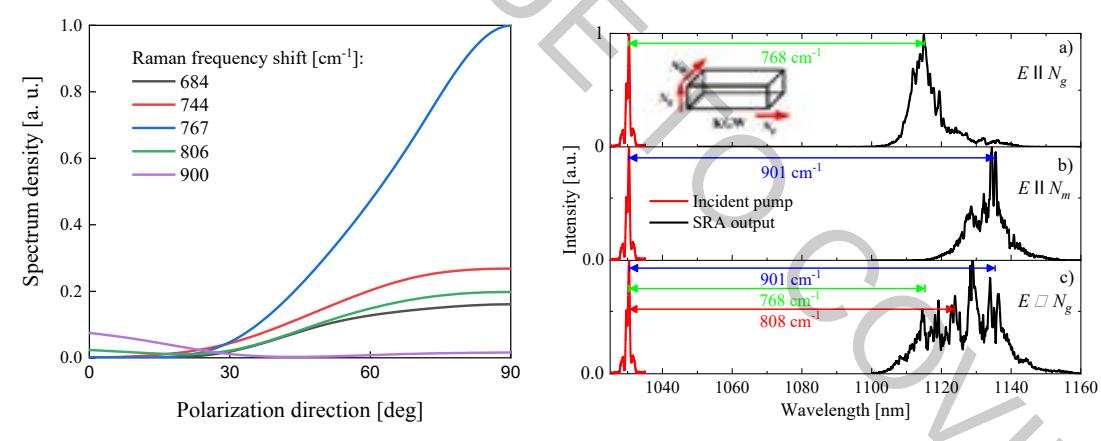
When the pump and seed polarizations were oriented at an angle between 24 and 27° with relative to the Ng axis (Fig.1. left), multiple Raman frequency shifts become possible. In this case, Raman lines 768, 808 and 901 cm-1 of the KGW crystal were involved in the formation of a common SRA gain bandwidth of ~25 nm FWHM (Fig. 1c). Thus, SRA gain bandwidth in KGW is more than 15 times the spectrum width of the incident pump pulse of ~1.6 nm. With a pump energy of 3 mJ, an SRA conversion efficiency of 8% was achieved.