
Hybrid organic-inorganic perovskites have been gaining more attention in recent years due to their desirable properties such as a tunable bandgap, solution processability and prospects for optoelectronic applications. During last decade solar cells, LEDs, lasers [1], transistors [2] and photodetectors [3] were created from perovskites. Therefore, they require further scientific investigation in order to optimize these materials for commercialization.
The main goal of this work was to study perovskite samples PEAnFAn-1PbnBr3n+1 of different dimensionality. Inside them there were increasing number of layers (N) of perovskite elementary cells sandwiched between organic ion layers. Carrier dynamics was investigated using light-induced transient grating (LITG) technique. Photoelectric parameters such as diffusion coefficient and recombination lifetime were obtained from these measurements.
Investigated layers were excited by 351 nm pulsed laser irradiation creating transient grating in the samples. Decay of this grating was observed using a probe beam of 1053 nm which was delayed by an optical delay line. Optical attenuator was employed to change the excitation energy fluence ($\Phi$), allowing to analyze photoelectric properties of perovskite samples within the wide range of excess carrier density (1018 – 1019 cm-3). Diffraction efficiency ($\eta$) decays, measured at three different grating periods $\Lambda$ (Fig. 1 (a)), allowed us to extract carrier lifetime ($\tau$R) and diffusion coefficient (D) using Eq. (1):
$$\frac{1}{\tau_G} = \frac{1}{\tau_R} + \frac{1}{\tau_D} = \frac{1}{\tau_R} + \frac{4\pi^2 D}{\Lambda^2} \tag{1}$$
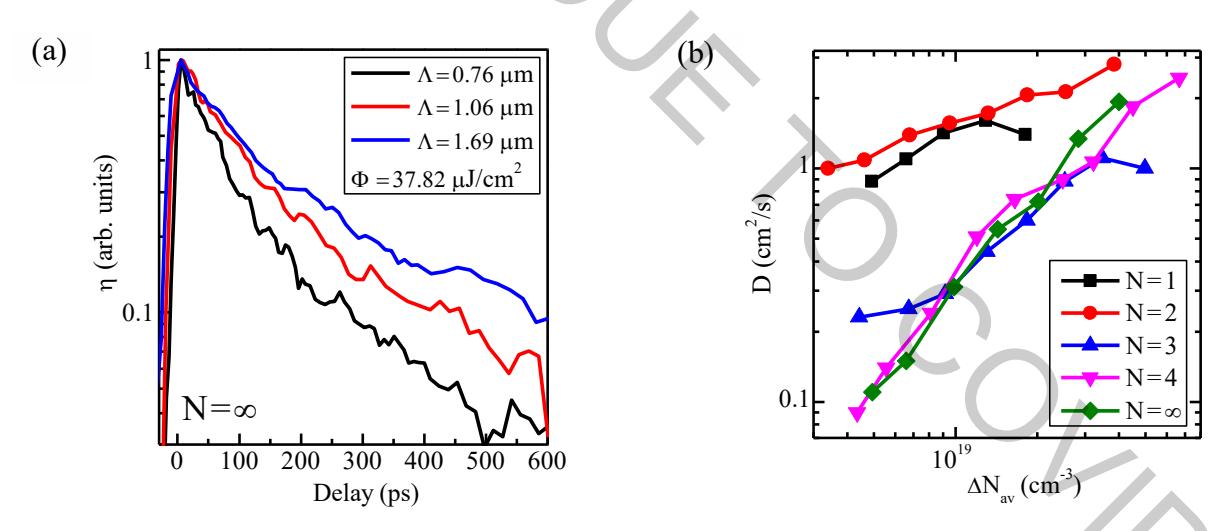
In Fig. 1 (b) it can be seen that diffusion coefficient increases with excitation. Also, samples with fewer perovskite layers have a higher diffusion coefficient value which changes only slightly with increasing excitation compared to samples with higher dimensionality. This can be attributed to the carrier delocalization [4]. It is stronger in perovskite samples with more layers, therefore we see greater change in diffusion coefficient compared to their more confined counterparts. Longer carrier lifetimes in samples with higher dimensionality also can be related to stronger localization.