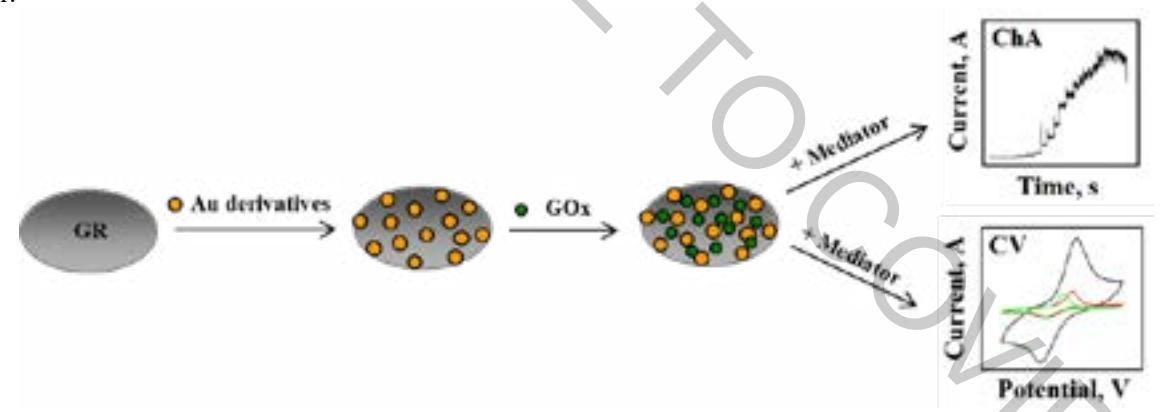
In the world especially grows the interest of high-technology (nano-, bio-) application in practical analysis [1]. Biosensors are complex, high-performance laboratory instruments, which can quickly, accurately, conveniently determinate and measure the biological interactions and components [2]. Enzymatic biosensors based on the principle of the affinity were used in laboratory practice and later found a successful production progress in domestic consumption [3]. Colloidal gold and redox mediators are able to increase the electron transfer in analytical systems and improve the sensitivity of the detection [4,5]. Immobilized by enzyme and gold compounds biosensors are characterized by high selectivity, sensitivity, rapidity, reversibility, reproducibility, practical application and excellent catalytic activities [5,6].
The main aim of this research was to create glucose biosensors immobilized by glucose oxidase (GOx) and modified by different size of gold nanoparticles or electrochemically synthesized gold nanostructures in the presence of soluble (phenazine methosulfate) and insoluble (1,10-phenanthroline-5,6-dione) mediators. The enzymatic polymerization of 1,10-phenanthroline-5,6-dione was performed on modified by enzyme and gold derivatives surface of graphite rod (GR) electrode. Gold derivatives in a combination with glucose oxidase offered some advantages for the design of electrochemical glucose biosensors and are able to facilitate indirect electron transfer, via mediators and show the positive effect on the electrochemical signals [7]. During our investigations the most suitable immobilization method by gold derivatives, the kind of working electrode and of redox mediator were chosen in order to increase the sensitivity of glucose's detection. Chronoamperometry (ChA) and cyclic voltammetry (CV) were used to register analytical signals of glucose. It was evaluated, that graphite electrode is more suitable for enzymatic immobilization than glassy carbon electrode. The highest analytical signal of glucose was achieved by the use of gold nanostructures. The use of phenazine methosulfate as redox mediator in analytical system increased analytical signal of glucose about three times in the comparison of 1,10-phenanthroline-5,6-dione. However insoluble in water mediator could take more advantages (the cover of electrode, the absence of interfering compounds) in the comparison with soluble in water mediator.