Ultrashort ultraviolet (UV) pulses are very desirable and widely applicable in time-resolved spectroscopy [1]. Unfortunately, supercontinuum (SC) generation in this particular spectral range is complicated due to unfavorable physical factors such as low order nonlinear absorption and high material dispersion, which increases with frequency and limits the achieved broadening of SC spectrum. Additionally, during filamentation of UV laser pulses, due to large incident photon energies, materials experience optical degradation and eventually, optical damage.
Therefore, it is more convenient to use visible or near infrared (IR) input wavelengths for UV SC generation. It was shown that alkali metal fluorides (LiF, CaF2, MgF2, BaF2) produce SC spectra with blue shifts reaching below 300 nm and, in this aspect, outperform popular visible and near IR SC materials like YAG or sapphire [2,3]. However, fluorides demonstrating largest SC spectral blue shifts (LiF and CaF2) experience other issues such as rapid color center formation and consequential SC spectral narrowing (LiF) and heat accumulation which leads to optical damage (CaF2). These challenges encourage the search for new suitable nonlinear materials for UV SC generation. An attractive candidate is lithium strontium hexafluoraluminate (LiSrAlF6, LiSAF) – a laser host crystal usually doped with chromium or cerium. Chromium doped LiSAF produces tunable laser pulses in the near IR region [4] while LiSAF doped with cerium is an appealing solid-state laser material, providing pulses in 280-320 nm range [5] and, therefore, highly resistant to intense UV irradiation. Additional LiSAF properties include a very large bandgap of 11.79 eV [6], 116 nm short-wavelength absorption edge, low refractive index and low chromatic dispersion from UV to near IR spectral range. The listed properties make LiSAF a potentially appealing material for SC generation in the UV spectral range.
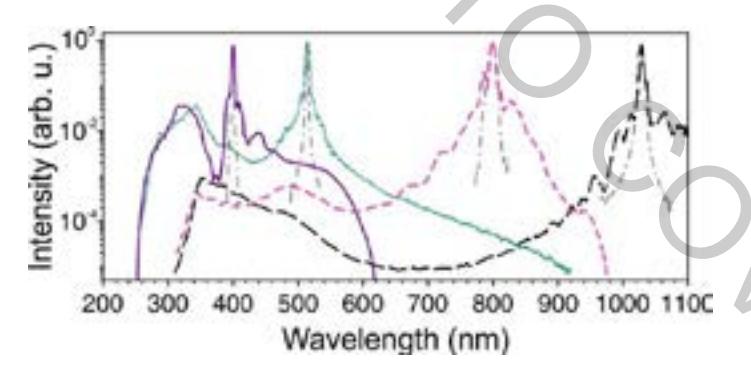
In this Contribution, we present an experimental study of SC generation in an undoped 5 mm thick LiSAF crystal using UV, visible and near IR pump pulses as provided by fundamental and second harmonics of femtosecond Ti:sapphire and Yb:KGW lasers. SC spectra generated in LiSAF at respective wavelengths are depicted in Fig 1. In order to evaluate the spectral longevity of the UV SC generated in LiSAF, we investigate spectral dynamics of the blue part of the SC spectrum over time (not shown). Our measurements demonstrate that narrowing of the SC spectrum due to optical degradation of the crystal starts much earlier with pump pulses of longer wavelength. This observation is explained by the impact ionization, which increases with increasing the pump wavelength. The most stable SC generation is achieved with the shortest pump wavelength of 400 nm where LiSAF produces a 1.28 octave spanning SC spectrum with a UV cut-off at 253 nm (measured at 10-5 spectral intensity level) and shows no spectral degradation for two hours of operation at 500 Hz repetition rate without translating the crystal.