Lemons are among the world's most popular citrus fruits. Lemons contain many plant compounts, minerals and essential oils additionally they are a great source of vitamin C and fiber. Lemon juice can be used in various fields: medical, cosmetic, food, chemical, etc. Additionally, reactions in lemon juice are an interesting subject in green chemistry.
Pyrazoles are an interesting class of five-membered heterocyclic compounds which show diverse activities (biological activities, ligands in cross-coupling reactions and optical sensors) [1]. Among them tetraarylpyrazoles exhibit luminescence properties [2]. There are several methods for the synthesis of pyrazoles, such as: reaction of chalcones and hydrazines, coupling of hydrazine, aldehyde and ethyl acetoacetate but these reactions are often performed at elevated temperature in organic solvents, and in the presence of different harmful catalysts [3].
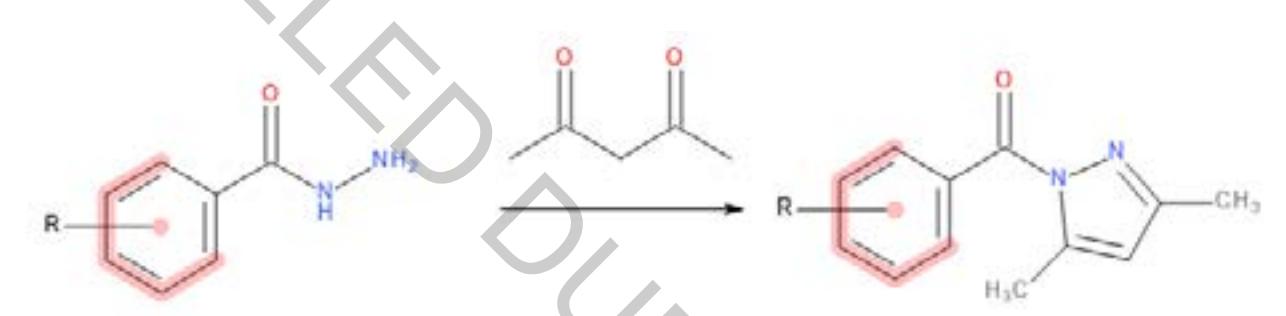
Reactions using lemon juice as medium are eco-frendly. In our research we used lemon juice as a medium in the synthesis of N-acyl substituted 3,5-dimetylpyrazoles with luminescent properties (Fig. 1). Different aromatic carbohydrazides were transformed into expected pyrazole derivatives with high yields. Pyrazoles with large aromatic substituents have luminescent properties in solution as well as in the solid state.