
Supercontinuum which covers an optical octave is a prerequisite to single-cycle optical pulse synthesis and isolated attosecond pulse generation, also a broadband radiation with high pulse energy facilitates seeding ultrafast optical parametric amplifiers, high-speed data acquisition in optical coherence tomography as well as ultrafast, multi-dimensional molecular spectroscopy [1]. There are several ways to broaden laser pulse spectrum, for example by generating supercontinuum radiation in gaseous environment or in a bulk medium. Recent papers have shown that there is an alternative for a supercontinuum generation in a bulk medium – thin plates [2].
The main reason why primary spectrum experiencing broadening is a nonlinear phase shift, which is related to change of spectra [3]:
$$\delta_W(t) = \frac{\mathrm{d}}{\mathrm{d}t} \Phi_{nl}(t) \tag{1}$$
By replacing whole medium into separate thin plates (for example thickness of a plate is 0.1 mm) we can use higher pump power for supercontinuum generation than in case of continuous medium. Consequently, the broadband continuum pulses have much higher pulse energy, thus making this kind technique for continuum generation is more applicable. This method is rather new still requires tedious investigation to fully understand its limits and capabilities.
Thus, we have performed experiment with multi-plates setup in which we used two 0.2 mm thick and five 0.1 mm thick plates fabricated from UVFS.
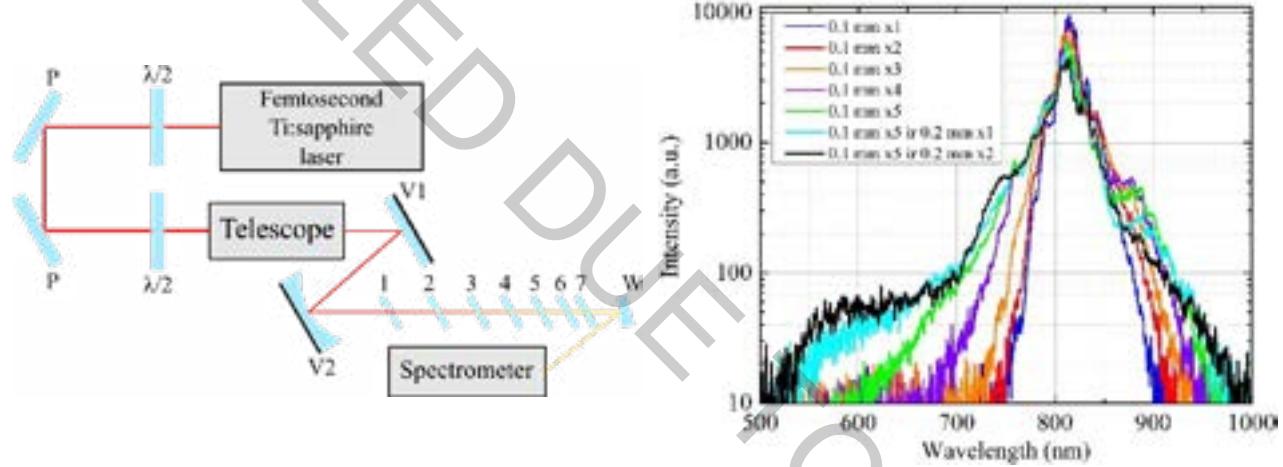
Multi-plate setup was pumped by 50 fs pulses from Ti:sapphire laser and pulse energy as high as 0.5 mJ was used in experiment. The appropriate focusing conditions were achieved by using telescope. In this setup the Ti:sapphire laser pulses spectrum of 25 nm at FWHM was broadened to the spectrum covering from 500 nm to 1000 nm. The result values of spectral energy density exceed up to thousands of times those reported in literature by generating a single filament in solid media. Continuum radiation from multi-plate setup has quite high energy stability over time. Standard deviation of continuum pulses acquired during one-hour continuous operation was of order 0.02.
Presentation will include more data on energy, spectral, spatial and stability characteristics of high energy continuum produced in multi-plate setup.