We demonstrate the emergence of a non-Abelian geometric potential and thus a three-dimensional (3D) spin-orbit coupling (SOC) for cold atoms without using laser beams, namely by subjecting an atom to a periodic perturbation [1]. This perturbation is taken to be the product of a fast-oscillating periodic function and a position- (and possibly time-) dependent Hermitian operator. Our analysis focuses on the case where the aforementioned Hermitian operator depends on internal states of the atom and therefore does not necessarily commute with itself at different positions. If the operator is taken to be self-commuting at different positions the system becomes equivalent to the one of the Kapitza problem [2], therefore our work can be seen as its extension. For the SOC to have a significant effect we consider a situation where the interaction amplitude is of the same order as the driving energy, and thus overcome limitations present in the previous works.
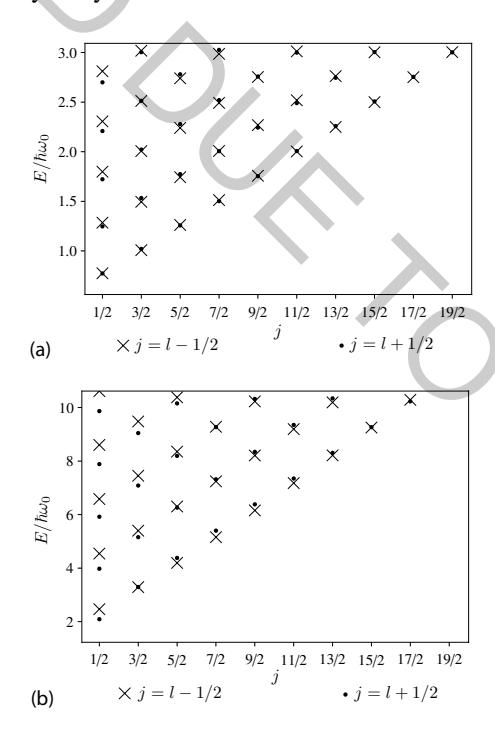
The general formalism is applied to the study of a spinful particle in a fast-oscillating spatially inhomogeneous magentic field. It is shown that a spherically symmetric magnetic field generates a fine-structure-like 3D SOC of the form $\mathbf{L} \cdot \mathbf{S}$. For large distances the coupling strength drops as $1/r^2$ and thus is long-ranged compared to the atomic fine-structure interaction. Such SOC affects the higher states of the trapped atom as well as the lower ones. It is shown that states with the same total agular momentum are nearly degenerate (Fig. 1). This degeneracy may be lifted by changing the trapping potential for the cold atoms. It is demonstrated that by introducing a specially tailored anti-trapping potential the state charecterized by the orbital quantum number l=1 becomes the ground state, which is not typical for a spin-orbit coupled system and may lead to interesting many-body behavior.