
Highly luminescent quantum dots (QDs) are generally made using high-temperature syntheses in organic solvents. Core-shell QDs (e.g. CdSe/ZnS) possess high photostability and quantum yield, broad absorption, and narrow emission peaks and have found wide application in biological and biomedical applications [1]. Since QDs synthesized in organic media are highly hydrophobic, and biological applications require water-soluble QDs. Among others, the encapsulation of QDs with amphiphilic polymer has proven to be the most effective approach that allows preparing colloidal stable water-soluble QDs with low hydrodynamic size and preserve their unique optical properties [2]. Additionally, chemical modification of the polymeric shell with various functional groups enables control of the surface charge and hydrodynamic size of QDs.
The purpose of this work was to create a new approach to modify poly(maleic anhydride-alt-1-tetradecene) (PMAT) with various functional groups which is then used for the encapsulation of CdSe/ZnS core-shell QDs. Also, we studied variations in the surface charge with respect to pH and a type of functional group embedded into the polymer.
The idea was to modify PMAT with molecules with various functional groups to create a polymeric shell of QDS with a different sign of surface charge, its magnitude, and its relation to the pH of the media. Chemical modification of PMAT was performed according to the procedure that involved the reaction of PMAT in organic solution with bifunctional molecules, containing both primary NH2-group and different charged groups (sulfonate, sulfate, phosphate, phosphonate and quaternary ammonium groups). After chemical modification of PMAT with selected agents hydrophobic CdSe/ZnS core-shell QDs were encapsulated by modified PMAT according to the standard protocol [3]. Encapsulated QDs were dissolved in different 0.01 M buffer solutions with the pH ranging from 4.5 to 9.5. $\xi$-potential and hydrodynamic size of water-soluble QDs were measured with the dynamic light scattering analyzer Malvern Zetasizer NanoZS90.
Encapsulated with PMAT 100% modified with phosphonic and sulfonic groups QDs results in a $\xi$-potential of approximately - 38 mV (Fig. 1, A). Embedding of phosphate and sulfate groups into the PMAT leads to a $\xi$-potential around to -23 mV. Sulfate- and sulfonate-modified PMAT shows almost constant $\xi$-potential value in overall pH range, while phosphate, phosphonate, and carboxylic groups show on the surface of QDs leads to increase the negative value in basic buffers due to weak acidity for their monomolecular inorganic analogs.
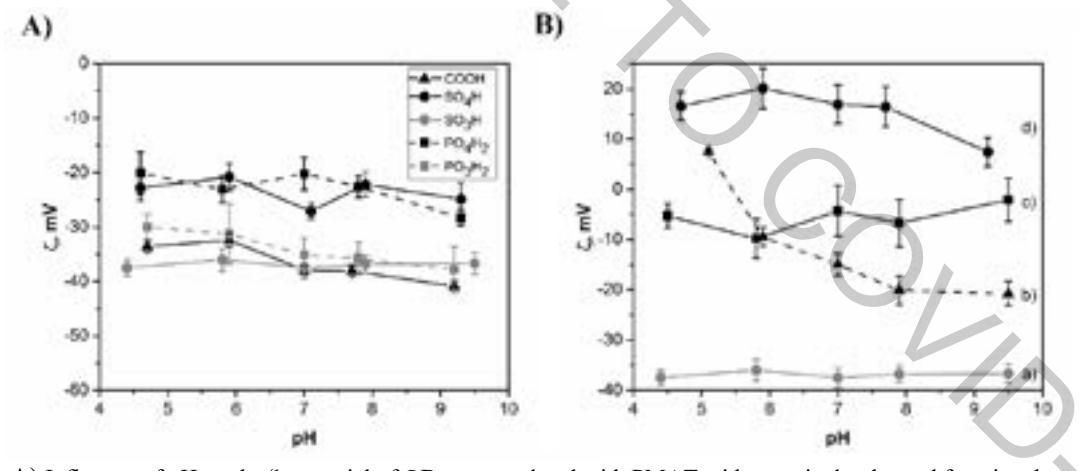
Modification of PMAT with 100% of (2-aminoethyl)trimethylammonium chloride results in a constant positive $\xi$-potential of encapsulated QDs around +17 mV in the biological pH range of 5-8, then it drops at pH above 8 (Fig. 1, B-d). Partial, 50 % modification of PMAT with quaternary ammonium groups gives encapsulated QDs with pH-dependent $\xi$-potential. At acidic pH, $\zeta$-potential is +13 mV, while in basic solutions zeta potential drops down to 20 mV passing through zero. Therefore, we can change $\xi$-potential of our QDs by varying the pH of a solution.