Nowadays, organic-inorganic perovskite (OIP) is the most perspective photoabsorbing layer for photovoltaic application [1]. Power conversion efficiency of the OIP solar cells reaches over 25% [2] with the possibility of cheap and easy synthesis from solutions [3]. Actually, the main problem of them is fast degradation under environmental influence: moisture, oxygen, heat and light-soaking [4]. We are able to prevent the impact of the first 3 factors using encapsulation and chemical modification of OIP layer [4], but we can't limit illumination. So, scientists try to reveal mechanisms and reasons of photoinduced processes in OIPs.
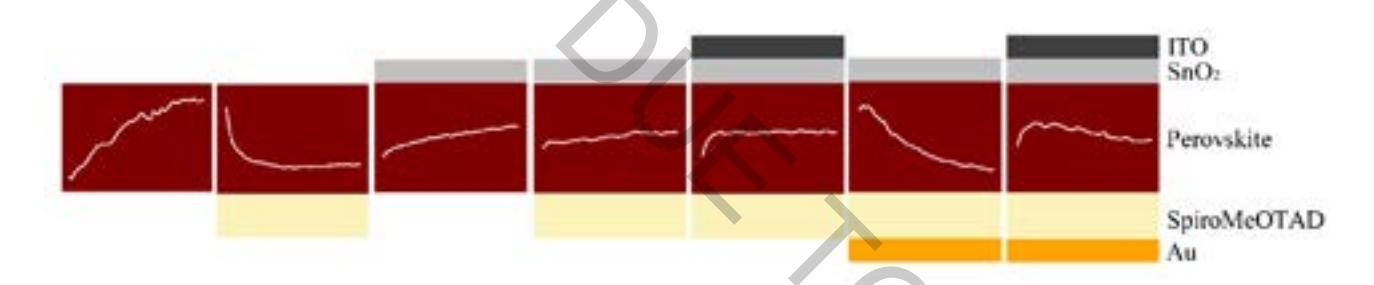
Our recent investigation [5] showed that functional layers as electron-transport layer (ETL), hole-transport layer (HTL) and contact layers have strong influence on the OIP properties especially on the charge carriers' transport and recombination. We have been studied organic-inorganic perovskite solar cells and the simplest structures based on (Cs/FA)Pb(I/Br)3 perovskite with different combinations of functional layers: (a) individual perovskite, (b) SnO2/perovskite (SnO2 is ETL), (c) perovskite/Spiro-MeOTAD (Spiro-MeOTAD is HTL), (d) SnO2/perovskite/Spiro-MeOTAD, (e) ITO/SnO2/perovskite/Spiro-MeOTAD, (f) SnO2/perovskite/Spiro-MeOTAD/Au, and (g) full solar cell structure ITO/SnO2/perovskite/Spiro-MeOTAD/Au.
Using confocal spectroscopy, we obtained photoluminescence kinetics (Fig.1) and established that the biggest changes in perovskite charge carrier's properties occurred at the HTL – perovskite interface. It is interesting to note that this influence is powered by gold contact. The obtained results have shown the necessity of the next investigation of photoinduced processes in the OIP solar cells and structures with different HTL and back contact layer.