
There are many factors contributing to the colour of both conventional and upconversion emission such as chemical composition of matrix, crystalline structure of upconverting materials, etc. Yb3+ ions, which are part of researched Yb-Tb-Eu system, absorbs 980 nm radiation and transfers the obtained energy to Tb3+ ions which then can emit green light themselves or transfer energy to Eu3+ ions, if they are in close vicinity, which would lead to orange/red emission of Eu3+ ions. Moreover, the investigated BiPO4:Yb3+,Tb3+,Eu3+ phosphors are able to form three different crystalline structures: trigonal, low-temperature monoclinic and high-temperature monoclinic, which also affects colour of luminescence. Thus, the purpose of this research is to produce green-to-red emitting luminescent materials by manipulating Tb3+/Eu3+ ratio and crystalline phase of phosphor.
The investigation of structural, morphological and optical properties of the synthesized compounds was carried out by powder X-ray diffraction (XRD), scanning electron microscopy (SEM) analysis and UV-VIS-NIR spectroscopy.
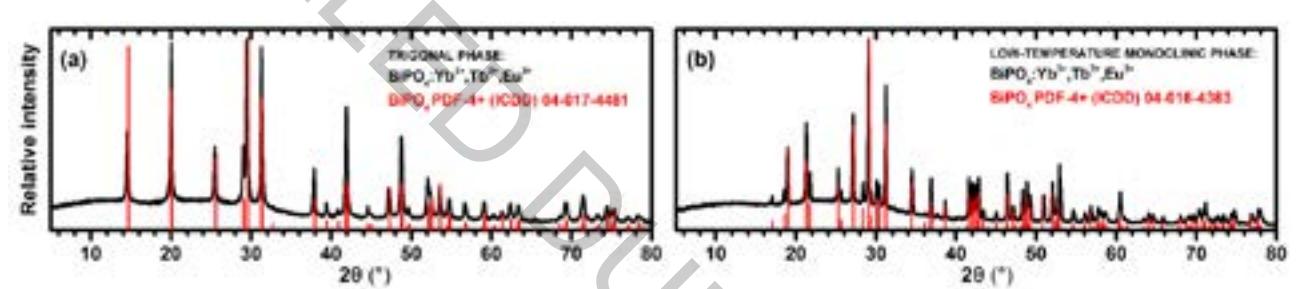
BiPO4:Yb3+,Tb3+,Eu3+ samples with trigonal and low-temperature monoclinic crystal structure (Fig.1 (a) and (b) respectively) were synthesized via co-precipitation and high temperature solid-state reaction methods.[1,2] The XRD patterns of produced samples correspond well with the reference patterns. In addition, single phase compounds are obtained at any Tb3+/Eu3+ ratio.
Reflection, excitation and emission spectra, decay curves, photoluminescence lifetime values, CIE 1931 colour space coordinates of BiPO4:Yb3+,Tb3+,Eu3+ phosphors were also investigated and will be discussed.