Nowadays, lithium-ion batteries have become very popular power sources for various devices as notebooks, mobile phones or even cars. With enormous demand for such usage, arrived a necessity for new materials and new technologies in this domain.
In this work, vanadium-doped lithium-manganese borate (LiMn0.875V0.05BO3) was synthesised using simple sol-gel method. Lithium-manganese borate (LiMnBO3) exhibits high gravimetric capacity (222 mAh·g-1) [1]. On the other hand, electronic conductivity values are only mediocre (3.64·10-7 S·cm-1) [2]. To handle this, the material was doped with vanadium, which can exists on a few levels of oxidation, what should improve electronic conductivity. What is more, material was synthesised using sol-gel method, what result in high porosity of resulting product. This should also have positive effect on conductivity. In this work, an impact of different pH conditions in sol-gel synthesis was studied.
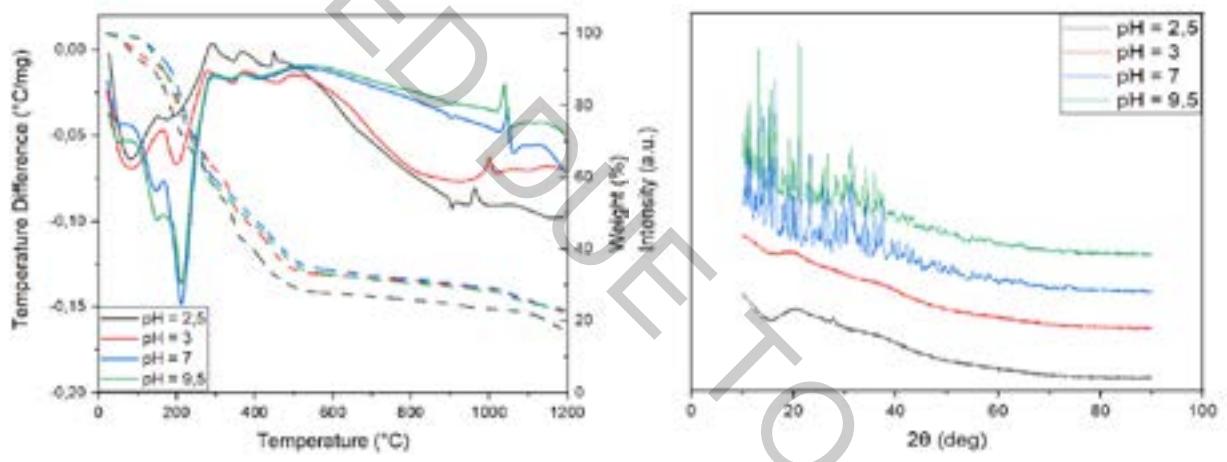
We performed syntheses of gels in acidic (pH = 2.5 and pH = 3), neutral (pH = 7) and alkaline (pH = 9.5) environment. Resulting gels and composites were examined using DTA/TGA, XRD and IS methods. The results of DTA/TGA are shown in Fig. 1. We can deduce temperature of calcination for resulting material, which can be determined as temperature at which there is no further mass loss. In this case, this temperature is around 700-800°C. The results of XRD shown in Fig. 2 provide information that for pH = 7 and pH = 9.5 acquired gels have not amorphous but crystalline structure. The IS measurements showed the existence of mixed electronic-ionic conductivity in samples.