The history of ferroelectrics starts back in 1940s. Ferroelectric materials are known for having a high dielectric permittivity value. Usually in ferroelectrics temperature of second-order phase transition is related with maximum value of real dielectric permittivity temperature. Also, there is a related group of ferroelectrics that received special attention for the past decades due to extraordinary dielectric properties – relaxor ferroelectrics (relaxors) [1].
Compared to 'normal' ferroelectrics, relaxors have several distinctive features, which does not correspond to structural phase transition. Relaxors have a diffuse peak of dielectric permittivity. the maximum value of real ($ \epsilon $') and imaginary ($ \epsilon $'') components of the dielectric permittivity are observed at different temperature values for the different probing frequency [1],[2].
Pb(Zn1/3Nb2/3)O3 (PZN) together with Pb(Mg1/3Nb2/3)O3 (PMN) are so called canonical relaxors and play a crucial role in the field of piezoelectrics and are highly suitable for ultrasonic transducers, electromechanical actuators [3]. The main goal of our work is to investigate dielectric properties of PZN–xPbTiO3(PT) single crystal along morphotropic phase boundary (MPB). In this paper four samples with different x concentrations (4.5PT, 6PT, 7PT and 12PT) were investigated.
The dielectric spectroscopy experiments were carried in two different experimental setups. The first one was done using impedance analyzer HP Agilent 4284A in the frequency range of 20 Hz to 1000 Hz. The second setup was done by measuring complex reflection coefficient using network analyzer Agilent 8714ET/ES in 1 MHz-300 MHz frequency range, while the sample is placed at the end of coaxial line.
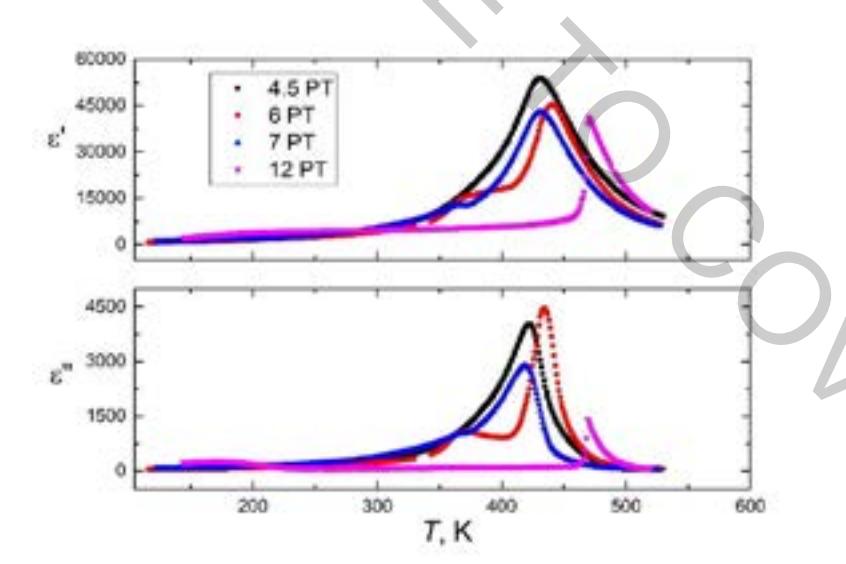
Below in Fig. 1 you can see temperature dependence of real ($ \epsilon $') and imaginary ($ \epsilon $'') components of dielectric permittivity. The sample with 4.5PT concentration has a usual single broad peak. In 6PT and 7PT concentrations we can observe two phase transitions, because we are approaching morphotropic phase boundary. In 12PT concentration we observe a single sharp peak and a phase transformation from cubic to tetragonal phase.