
Localization of charge carriers in shallow potential minima just below the band edges is typical for materials and structures with some level of disorder. In particular, this process is well known in III-nitrides alloys where it is believed to be the main reason for high internal quantum efficiency, in spite of high defect density [1]. The exact effect of carrier localization to carrier transport and recombination is difficult to analyze, though. Quantum wells of ternary nitride alloys is a very complex structure; thus, investigation of carrier localization demands a computational-heavy modelling [2] and sophisticated experimental methods [3].
One way to experimentally study the carrier localization is by observing the properties of carrier diffusion. In this presentation, we report the results obtained by Light-Induced Transient Grating (LITG) technique in InGaN/GaN/sapphire structures grown by MOCVD technique along the polar (c) crystallographic directions. We carry out LITG experiments to measure the ambipolar diffusion coefficient ($D$) of photoexcited carriers in quantum wells and thick layers. From the dependencies of $D$ on carrier density and photoexcitation wavelength, we analyze the impact of carrier localization on their transport and recombination pathways.
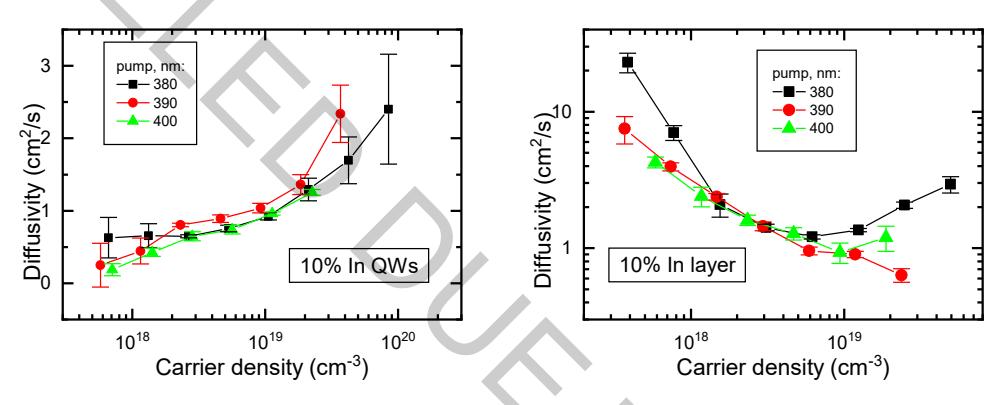
In Figure 1 we illustrate the obtained dependencies of $D$ on photoexcited carrier densities in either quantum well (left) or thick layer (right) samples. In both cases, diffusivity changes in a non-trivial manner that deviates from the standard Einstein relation. We demonstrate that such a complex behavior can explained by accounting for two processes: (i) at the highest excitations, diffusivity scales with the density due to carrier degeneracy, while at low densities $D$ is governed by the localization of carriers. Different dynamics of $D$ in the quantum well and epilayer samples can be explained by assuming the higher localization center density with higher potential barrier in the epilayer. This somewhat unexpected result suggests that the main mechanism for hole localization is due to random indium content fluctuations rather than quantum well thickness fluctuations. The impact of carrier localization is also seen from the dependence of $D$ on excitation wavelength: as the carriers are photoexcited to the localized states below the bandgap (pump wavelengths of 400 nm and 390 nm) the diffusivity value is lower than that obtained for direct band-to-band excitation (380 nm).