SELF-ASSEMBLED MONOLAYERS BASED ON FLAVIN COFACTOR FOR SENSING OF GLUCOSE
Delianas Palinauskas1, Gintautas Bagdžiūnas1, 2
1 Department of Material Science and Electrical Engineering, Center for Physical Sciences and Technology, Sauletekio av. 3, Lithuania
2 Institute of Biochemistry, Department of Bioanalysis, Life Sciences Centre, Vilnius University, Sauletekio av. 7, LT-10223, Vilnius, Lithuania
The recognition of bioanalyte toward self-assembled monolayers (SAMs) mostly on conducting surfaces can be employed as the sensing element of an electrochemical sensor. These SAMs as 2D layers seem to be the ideal approach of tailoring a surface and controlling electron transfer, which is the basis of an electrochemical sensor [1]. On the other hand, a number of experimental techniques [2,3] and theoretical methodologies [4] have been used for sensing of glucose in our group. In turn, flavin function group in flavin adenine dinucleotide (FAD) is a redox-active coenzyme associated with various proteins such as glucose oxidase, which is oxidized glucose to gluconic acid [2, 3].
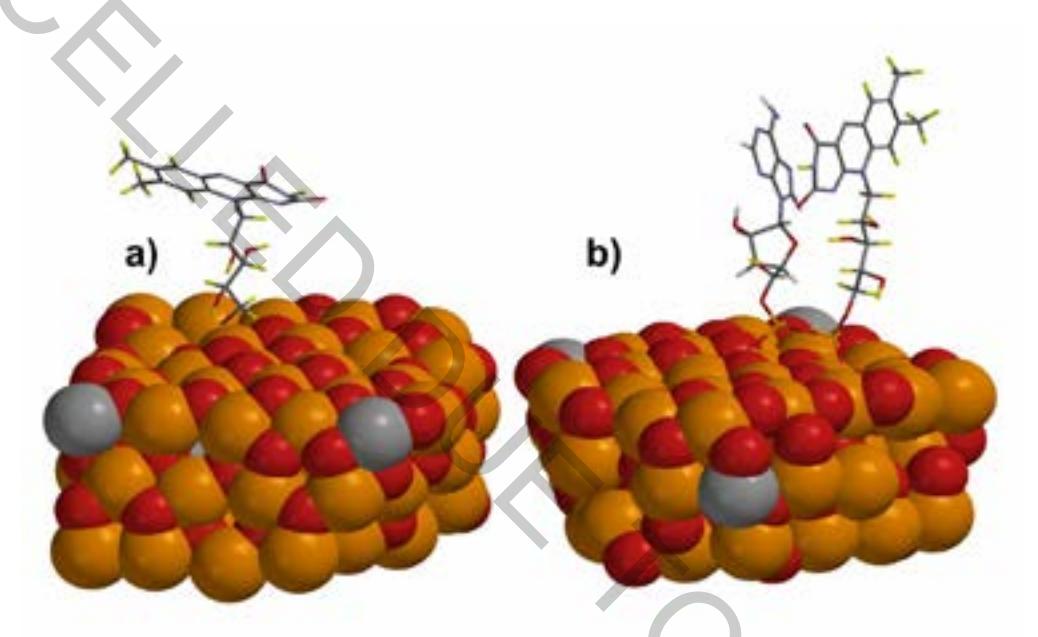
Fig. 1. Optimized molecules of RFL (a) and FAD (b) on surface of ITO.
Herein, for the first time, an electrochemical investigation of SAMs based on riboflavin (RFL), also known as vitamin B2, and flavin adenine dinucleotide (FAD) on indium tin oxide (ITO) coated glass as the working electrodes will be presented. These monolayers were studied by using the cyclo voltamperometry (CV), chronoamperometry, Raman spectroscopy, as well as theoretical methods. Prepared SAMs based on these molecules were employed for sensing of glucose. We hope that this work will be useful for further research of electrochemistry of SAMs. These promising studies are ongoing in our scientific group.
Acknowledgments: Financial support from the Research Council of Lithuania a grant No. 09.3.3.-LMT-K-712-16-0260 is gratefully acknowledged.
[1] Mandler, D.; Kraus-Ophir, S. Self-Assembled Monolayers (SAMs) for Electrochemical Sensing. J Solid State Electrochem 2011, 15 (7–8), 1535–1558.
[2] Žukauskas, Š.; Ramanavičius, A.; Bagdžiūnas, G. Organic Semiconductors with Carbazole and Triphenylamine Moieties for Glucose Oxidase-Based Biosensors. J. Electrochem. Soc. 2019, 166 (6), B316–B321.
[3] Bagdžiūnas, G.; Žukauskas, Š.; Ramanavičius, A. Insights into a Hole Transfer Mechanism between Glucose Oxidase and a p-Type Organic Semiconductor. Biosensors and Bioelectronics 2018, 102, 449–455.
[4] Bagdžiūnas, G.; Ramanavičius, A. Towards Direct Enzyme Wiring: A Theoretical Investigation of Charge Carrier Transfer Mechanisms between Glucose Oxidase and Organic Semiconductors. Phys. Chem. Chem. Phys. 2019, 21 (6), 2968–2976.