
Ultracold polar molecules offer prospects for the creation of the molecular Bose-Einstein condensate with possible applications for quantum information and precision measurements [1]. One of the possibilities of obtaining molecular quantum matter with controlled properties is the transferring of the polar diatomic molecules to the ground rovibronic state by initial optical excitation into the overlying rovibronic states with specific forms of electronic terms. In this case for the high efficiency of excitation and subsequent relaxation of the molecular system the exact forms of the potential energy curves (PECs) of the combining electronic states can be obtained based on analysis and interpretation of high-resolution rovibronic spectra or cutting-edge ab initio calculations. The knowledge of the exact PECs also allows to define the important spectra-energetic characteristics of molecules and the macroscopic physical properties of rarefied gases.
Physical and chemical applications of ultracold molecules include ultra-high-resolution spectroscopy, few-body physics, quantum computation, molecular optics and controlled chemical processes [1]. Earlier [2] it was shown that diatomic molecules, which contain alkaline earth metal atom and halogen atom are promising for the direct laser cooling due to the matching equilibrium internuclear distances for different PECs.
In this study, ab initio state-of-art calculations of the low-lying doublet states of the RaCl molecule were performed for the first time (Fig. 1). The calculations at the SA-CASSCF(13,12)/XMCQDPT2 [3] level of theory were carried out in two stages taking into account static and dynamic parts of correlation energy in the range of internuclear distances from 2.26 to 12.50 Å. The PECs were analytically continued starting from 2.26 to 2.00 Å. The TZ-basis set for Cl atom and Stuttgart RSC ECP 78 for Ra atom were used in the calculations for three dissociation limits [Ra(7s2)+Cl(3p5), (Ra+(7s)+Cl-(3p6), and Ra+(6d)+Cl-(3p6)].
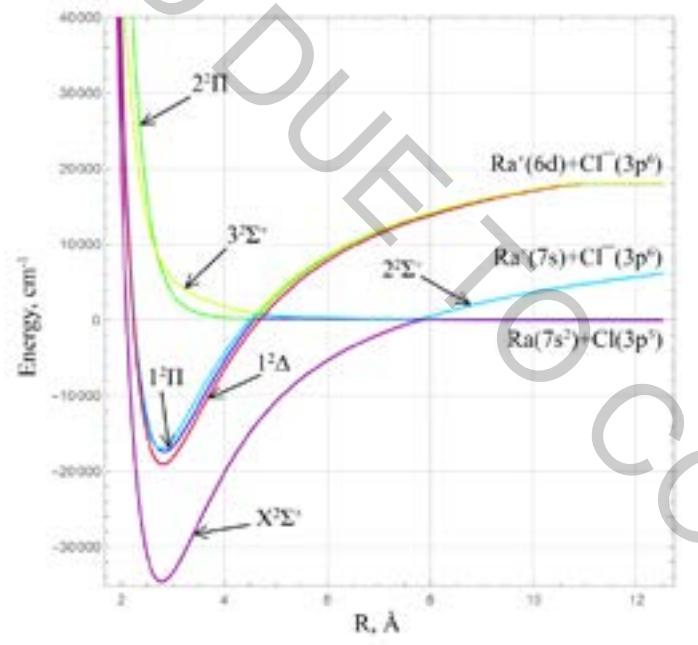
The results of our calculations for dissociation limits are in good agreement with energies of isolated atoms and ions. The PECs and spectroscopic parameters were obtained for the following low-lying RaCl terms: ground state $X^2\Sigma^+$ ($R_e = 2.776$ Å, $D_e = 34605.6$ cm-1), and excited states $1^2\Pi$ ($R_e = 2.821$ Å, $D_e = 17421.5$ cm-1), $2^2\Sigma^+$ ($R_e = 2.765$ Å, $D_e = 17040.9$ cm-1), $1^2\Delta$ ($R_e = 2.800$ Å, $D_e = 19087.6$ cm-1). It is worth mentioning that equilibrium internuclear distances of the ground and some excited states are close in value. The results also show that the diatomic polar molecule RaCl is a promising candidate for laser cooling and magneto-optical trapping.