
Thin film deposition technique is used to produce a variety of optical components which can be used in high power laser systems. In order to manufacture high quality components with high resistivity to laser damage, complex spectra and ensure process repeatability it is necessary to have accurate layer monitoring during deposition. Often used quartz monitoring is relatively accurate, however, the quality of quartz, its longevity and other factors may differ for each individual crystal, especially in higher temperature processes. Also, the quartz crystal only accounts for the number of particles deposited on it – the physical thickness. The important factor, however, is the layer's optical thickness, which also takes the refractive index into account. To enhance the accuracy, quartz monitoring is often used in conjunction with optical monitoring. The latter continuously measures the spectrum of a substrate during coating deposition process.
It is more difficult to install optical monitoring to record the growth of sculptured thin films due to constant changes in the evaporation angle between the substrate normal and evaporation angle (Fig. 1). It is important to continuously monitor the entire evaporation process at all angles since the refractive index changes with a changing angle (porosity increases with a greater angle). Therefore, a two-light-sources based monitoring system could be implemented in the vacuum chamber equipped with electron beam evaporation technology. The first experiments were performed to measure the transmission spectra of the growing thin film at 0 and 70 deg angles (Fig. 1 and 2).
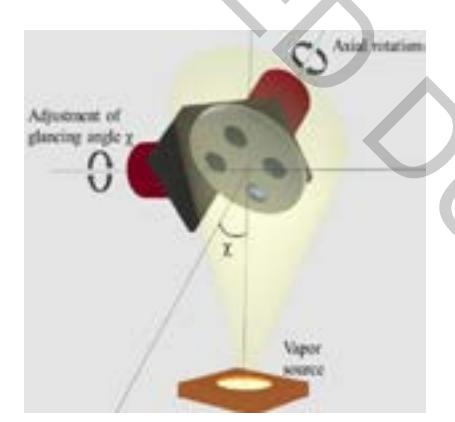
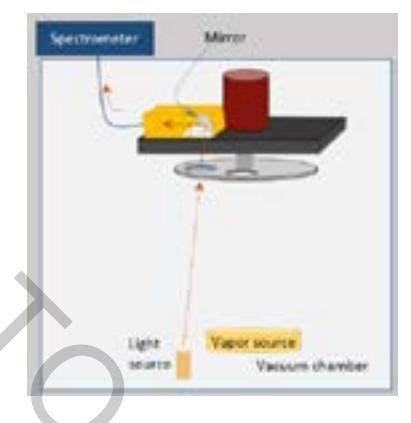
Obtained data was used to model optical constants of the growing thin film and compared with the properties of the thin films when exposed to the atmosphere. After a multilayer mirror was deposited using quartz and optical monitoring, an error analysis was performed and indicated the weak points of quartz crystal monitoring.
Comparing the two different monitoring systems it was found that the optical monitoring recordings were more accurate on single layers, nonetheless, the recordings of multilayers still need to be improved.