
The study considers the use of amino group containing precursors in microwave synthesis of cerium doped zinc oxide nanoparticles. At the moment precursors have become an integral part of the synthesis of various nanoparticles, because of their small quantity can significantly reduce particle aggregation and a decrease in the amorphous component of the synthesis product [1].
Using cerium doped zinc oxide as an example, we examined the effect of aliphatic and polycyclic amines as precursors - isopropylethylenediamine and urotropine and studied by X-ray diffraction analysis, fluorescence spectroscopy and scanning electron microscopy. A relationship between the sizes of nanoparticles and their crystallinity with the number of nitrogen atoms of the precursor molecules has been established [5].
Thus, urotropine containing 4 nitrogen atoms allowed us to obtain particles of 48 nm size and the crystallinity was 87.5%, while for particles obtained with a precursor containing 2 nitrogen atoms - isopropylene ethylenediamine it was 56 nm with a crystallinity of 85.5%.
The most important difference in the synthesis of results is found in the size of aggregates (Fig.1).
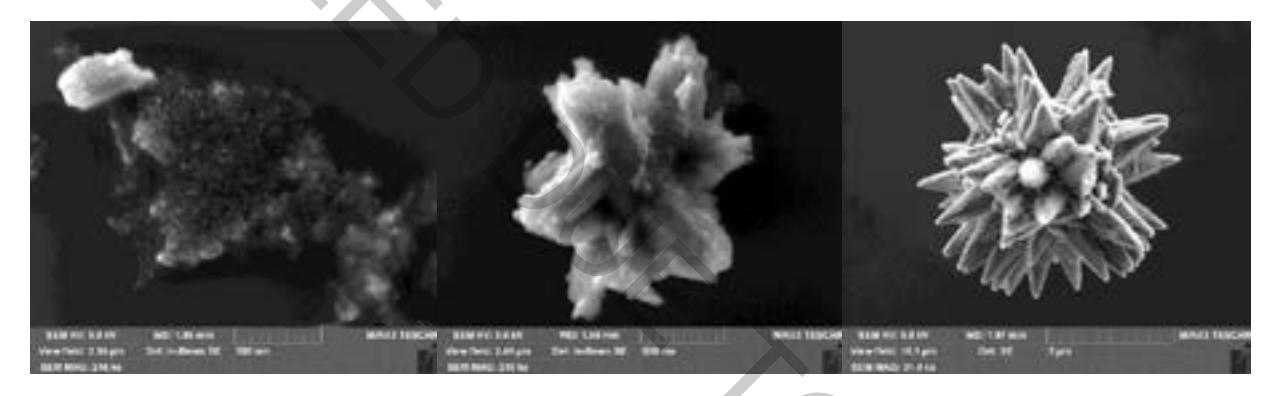
We found that the biggest agregates for urotropine are about 1.5 μm and 8 μm for isopropylene ethylenediamine which implies a more efficient growth when using an aliphatic compound. At the same time this effect is not observed for precursors based on glycols.