
Whispering gallery mode microresonators (WGM) are widely researched due to their high quality (Q) factors and sensitivity. High Q factor is the result of the structure of the resonator: microspheres, microbottles, microbubble/capillaries, microtoroids, microrings, and microdisks. These cavities have smooth edges, they are transparent, and their refractive index is higher than that of surrounding environment, and therefore continuous total internal reflection occurs. The structures confine resonant photons for long periods of time, allowing resonant optical fields to travel inside the resonator for multiple times, which increases the sensitivity of the sensors [1]. There are many applications to WGM microresonators, such as spectroscopy and fluorescence studies, generation of frequency combs, biosensing and many others [2]. This study explores WGM microresonator as a humidity sensor, using glycerol microsphere.
Precise humidity measurements are important in various sectors: industrial processing, environmental control, automobile industry, medical field, agriculture, and general industry [3]. However, the available humidity sensors can be slow and work properly only in medium humidity levels. This study researches the precise measurements of relative humidity (RH) both in high and low humidity, which is possible using a silica microsphere dipped in pure glycerol and a tunable laser. For the experiment, glycerol was chosen due to its hygroscopicity, transparency and its stability in time and temperature. Glycerol's ability to absorb and adsorb water from the surroundings until it stabilizes is the reason shift in WGM can be observed. As glycerol absorbs water, its radius and refractive index change, resulting in a shift in resonant wavelength:
$$m\lambda = 2\pi R n_{eff},\tag{1}$$where m is an integer number, $\lambda$ is the resonant wavelength, R is the radius and neff is the effective refractive index. It means that an integer number of wavelengths fit the optical path of the resonator [4]. In this experiment glycerol droplet of R = 0.5 mm was used. To obtain whispering gallery resonances tunable laser with wavelength 760 nm was used. Light from the laser excites the microsphere and shift in resonant frequencies was observed using an oscilloscope.
Results from this experiment are promising – glycerol as a resonator is stable both in time and temperature (no fluctuations due to change in room temperature were observed, the droplet did not evaporate or fall off the silica sphere with time), with fast reaction time, and it works in all ranges of RH. Using an oscilloscope, data was collected in the range from 55 to 65 % RH, shift in modes was observed. Results are presented in Fig. 1 where data was fitted to 5th order polynomial. However, further development of the experiment is necessary as at high humidity levels the volume of the droplet increases rapidly, and the laser beam no longer is focused in a way that excites WGM. Automated laser beam adjustment is necessary.
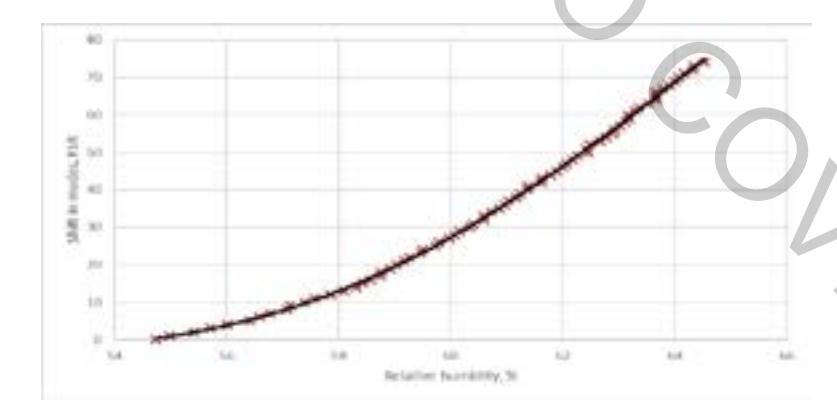
The results of this experiment show that glycerol droplet as a RH sensor is very precise, which is necessary for many industrial needs and scientific studies. Further research on this subject is necessary to test the resonator in low humidity levels, as well as test the repeatability and hysteresis of this sensor.