
Human steroid $7\alpha$-hydroxylase (CYP7B1, EC 1.14.13.100) is a microsomal liver enzyme, which takes part in the biosynthesis of intermediate bile acid products. In addition to liver cells. Human cells of the testes, ovary, kidneys and small intestine, prostate gland, large intestine and brain express CYP7B1 [1]. CYP7B1 hydroxylates various oxysterols and neurosteroids, for example DHEA (dehydroepiandrosterone), EPIA (epiandrosterone) [2, 3]. CYP7B1 dysfunction in the human body is associated with the development of a neurodegenerative disease with spastic paraplegia type 5a and osteoarthritis. However, the molecular mechanisms of these diseases are not fully understood due to lacking of information about chemical and physical properties of mutant form of the enzyme.
The aim of this work was to characterize the chemical and physical properties of the mutant form of CYP7B1 with the amino acid substitution Phe470Ile, associated with spastic paraplegia type 5a. For this, we screened the ligands of the active center of the mutant protein form and compared it with the existing data for the wild type. Screening was performed using spectrophotometric titration. To assess the ability of a potential ligand to bind to a protein, we used the constant of dissociation ($K_d$) of enzyme-ligand complex. There was found that five new ligands bind with protein mutant (Fig. 1): $5\beta$-androstane-17-one, $5\beta$- androstane -$3\beta$-ol-16-one, $5\alpha$- androstane-3-one, 5-androstane-$3\beta$, $17\alpha$-diol, 5-androstane-$3\beta$-ol-16–one, in contrast to the wild type.
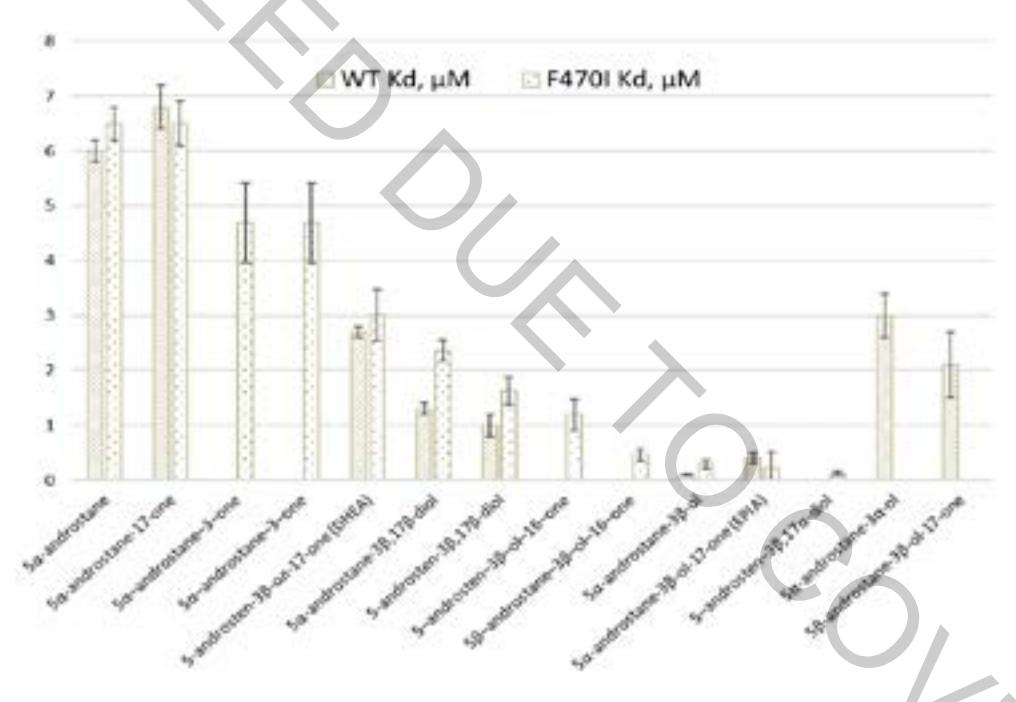
The data obtained indicate that the enzyme retains the ability to bind steroids and their derivatives, but the substrate profile for binding changes. The results of accelerated molecular dynamics that we have published previously indirectly indicate changes in the structure of the active center of the mutant protein that can explain the change in the ligand profile [4]. However, for an accurate and complete understanding of the changes caused by the Phe470Ile mutation, further experiments are required both in silico and in vitro.