
Protein kinase C (PKC) is a family of Ca2+-activated phospholipid-dependent serine/threonine protein kinases which regulates a lot of crucial processes in various types of cells and in particular – calcium sensitization and contractility of smooth muscles [1]. PKC is supposed to participate in oxytocin (Ox) effect in myometrium [2] but rather few studies elucidate its role in pathophysiologal uterine contractions. Investigation of PKC effects was conducted to find out its role in Ox-induced contractions and hypotonic stress response with usage of its specific antagonist chelerythrine (Che).
Experiments were done on pregnant rat myometrium (18 -22 days of gestation) and human myometrium at term. Tissue samples were obtained from pregnant women near term during elective caesarian section. All volunteers gave written informed consent. All experiments on animals were also conducted in accordance to bioethics principals and the study was approved by the Institutional Ethics Committee for Research. Contractility was studied with isolated tissue bath method [3]. Myometrium strips were perfused in modified physiolological salt solution of normal and reduced (220 mOsmol/L) tonicity. Ox (10 nM, Sigma, USA) and Che (1 μM, Sigma, USA) were administered to the bath solution. Calculations and statistical analysis were made in Clampfit and OriginPro.
Effect of the PKC antagonist was studied by analyzing changes in several parameters of contractions – Peak Amplitude, Area under the curve, Half-width (T1/2), Rise Tau and Decay Tau. When Che was used in combination with Ox all parameters were lower than those after oxytocin application only. Also in these experiments Peak Amplitude and Area under the curve that demonstrates the load developed by muscular strip were increased in comparison to control contractions. Similar changes have been observed for Rise and Decay Tau, indicating that the phase of contraction and relaxation were depressed under these experimental conditions, as can be seen in Figure 1.
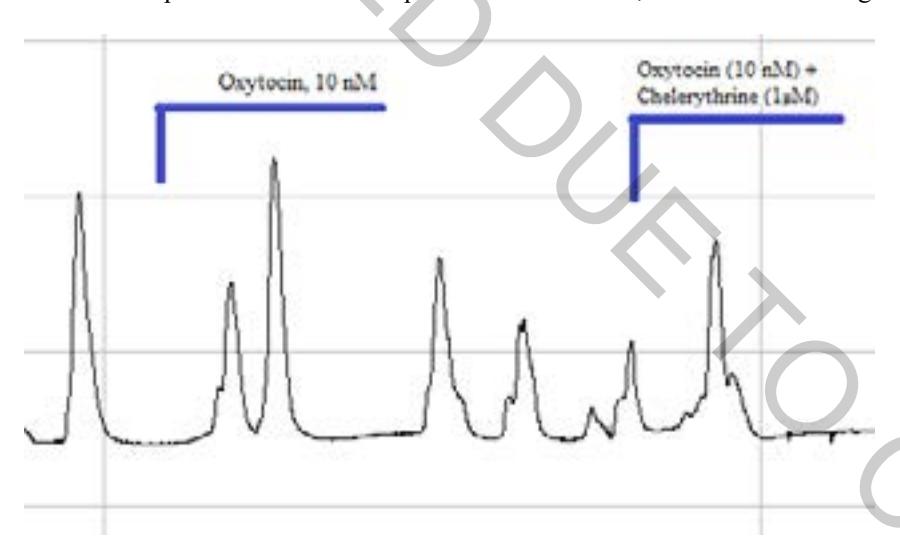
Che under hypotonic solution showed light the elevation in Half-width, Rise Tau and Decay Tau and fall in Peak Amplitude and Area under the curve . Because these changes were not significant we can conclude that PKC pathway could hardly be considered to participate in contractile response to mechanical stretch.
Results demonstrate that PKC play the minor role in the process of hormonal regulation of myometrium contractility. The contractile response of myometrium to hypotonic stress is PKC-independent.