Nitellopsis obtusa is a macroalgae found in fresh and brackish waterbodies. Its giant internodal cells (up to 30 cm in length) have been used in plant electrophysiology for decades, enabling thorough biophysical research of plant bioelectrical phenomena from investigations of single ion channel activity to cell-to-cell communication [1].
Nitellopsis cells, often called “green axons”, are excitable [2]. Exposure to external stimuli of various modality (electrical, mechanical, termo- stimulation, salt stress) may evoke generation of action potentials, remarkably similar to those observed in animal cells. In plants, an over-threshold stimulus abruptly depolarizes cell plasmalemma by activating voltage-dependent Ca2+ and Ca2+-dependent Cl- ion channels, thus allowing Ca2+ ion influx and subsequent Cl- ion efflux. Membrane repolarization is achieved by activation of voltage-dependent K+ ion channels (K+ efflux) as well as H+-ATPase activity (H+ efflux).
Our research aimed to investigate effect of Cs+ ions (known to block K+ channels [3]) on electrical signaling properties of Nitellopsis obtusa. Special attention was paid to repolarization phase of action potentials, since it is mainly governed by the activity of K+ ion channels. Nitellopsis action potentials in single cell were registered using conventional sharp microelectrodes via current clamp technique. Voltage clamp technique enabled evaluation of dynamics of cell excitation current transients. Patch clamp technique was used to investigate activity of tonoplast (vacuolar membrane) K+ ion channels.
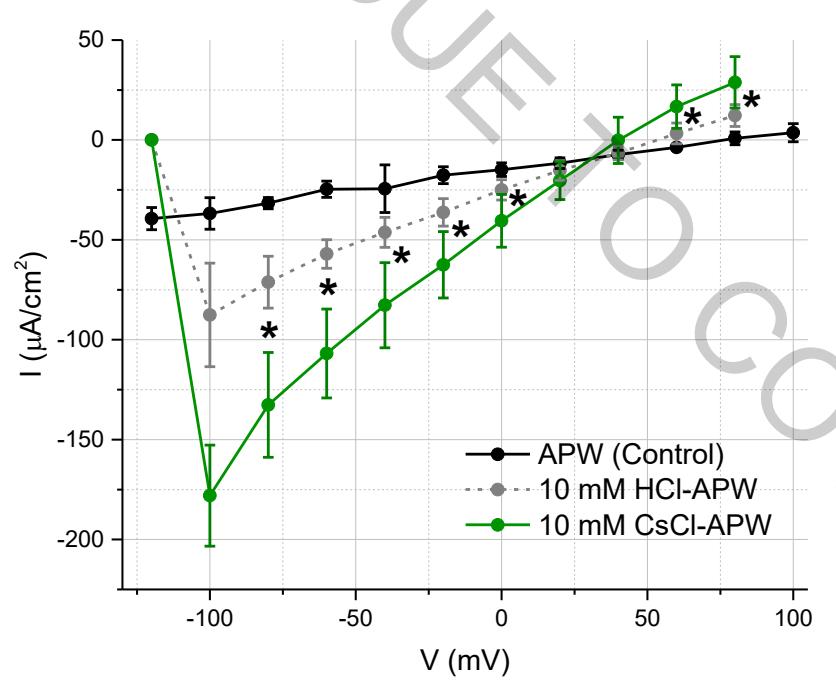
It was confirmed that tonoplast K+ ion channels are blocked by Cs+ ions. Cs+ ions substantially decrease velocity of repolarization of Nitellopsis action potentials and determine a characteristic shape. Unexpectedly, Cs+ ions also increase amplitude of excitation current transient (Fig. 1). The results indicate that Cs+ effect on electrical signaling patterns of Nitellopsis obtusa is complex and may involve altering activity of ion channels other than K+ channels.