Geobacillin 26 is a heat-labile, high molecular weight antibacterial protein from a thermophilic Gram-positive bacteria Geobacillus stearothermophilus 15 and it has a narrow antibacterial spectrum against other thermophilic bacteria. Its mode of action differs from similar bacteriolysins. In recent studies, it was proven, that geobacillin 26 is not a cell wall degrading enzyme, but its specific mode of action is unknown [1]. Bacteriocins, including geobacillin 26, have a great potential in the food industry where contamination with thermophilic bacteria is unwanted.
The study aimed to determine the mode of action of geobacillin 26 using Atomic Force Microscopy (AFM). AFM is a surface-sensitive technique that allows to visualize three-dimensional topographic views of a specimen under physiological conditions. Thus we established protocols to immobilize and visualize directly the activity of protein on bacterial and artificial cell membranes (tBLM – tethered bilayer lipid membrane).
Bacterial cells of sensitive strain Parageobacillus genomospecies 1 NUB36187 (9A11) were spread on NB-agar plate and incubated overnight at 55 °C. After the incubation biomass from the plate was transferred to NB medium and incubated overnight at 55 °C. The next morning the cell suspension was inoculated to the NB medium (55 °C) in the ratio 1:50. The cell suspension adjusted to OD (600 nm) of 0,6 and then affected with geobacillin 26. The cell suspension was washed with PBS (pH 7,4) buffer two times. The suspension was spread out on poly-L-lysine modified mica. Surface topography and force curves (elasticity and adhesion properties) of bacteria were analyzed.
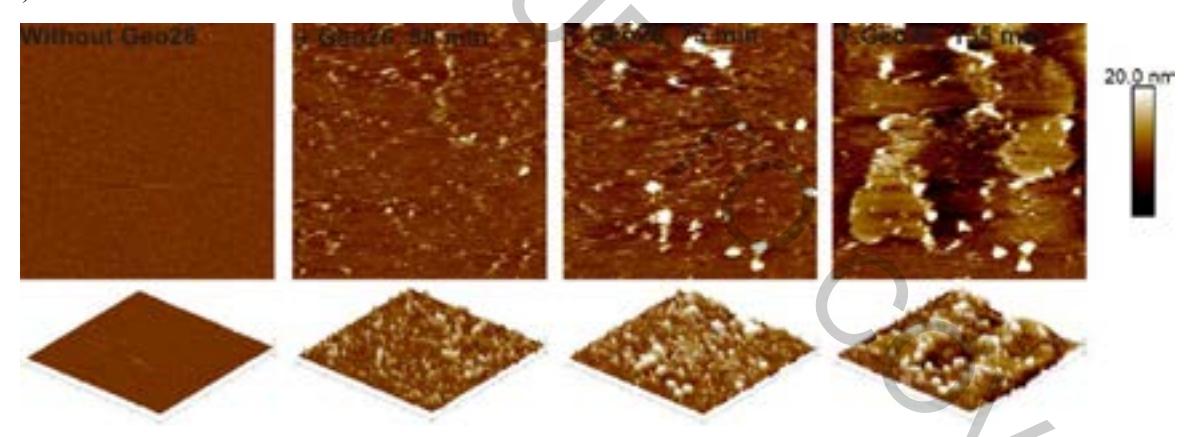
The artificial cell membranes were prepared as described elsewhere [2]. To imitate bacterial cell membrane, tBLMs were formed from 1,2-dioleoylphosphatidylglycerol/1,2-dioleoyl-sn-glycero-3-phosphoethanolamine7/3 multilamellar vesicle solutions .The effect of geobacilin 26 on the artificial bacterial membrane was detected via time-lapse capturing (Figure 1).