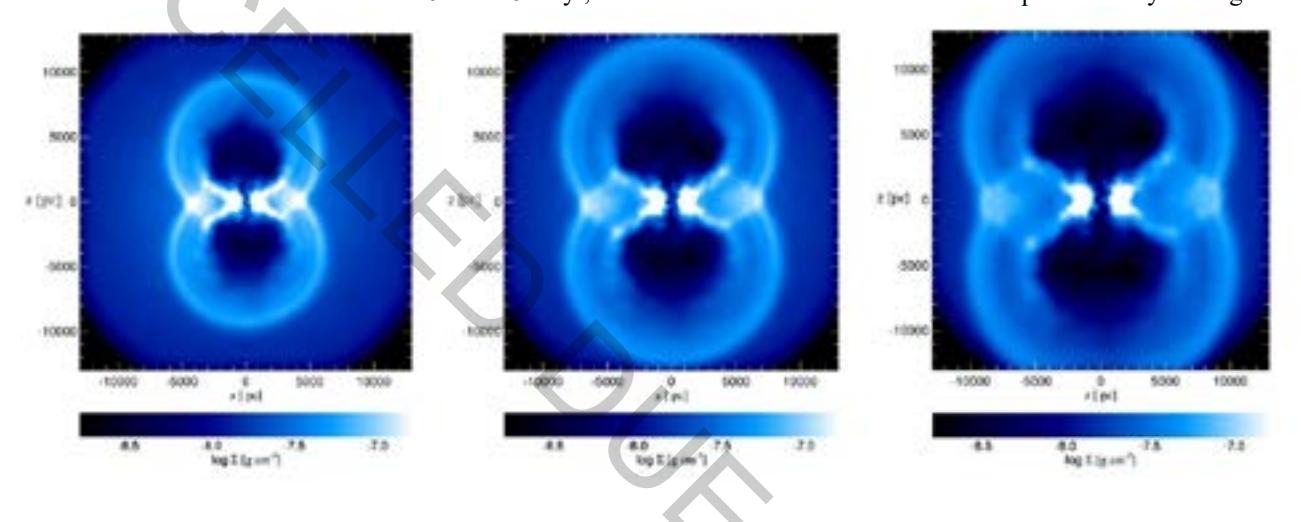
SgrA*, the supermassive black hole in the center of the Milky Way, is probably one of the most important ingredients in the formation and evolution of our Galaxy. Young star clusters Arches & Quintuplet and young massive stars in the central parsec indicate that Sgr A* might have been active in the past <10 Myr. Recently discovered giant gamma-ray structures, known as the Fermi Bubbles [1], could be one of the activity footprints of SgrA*. The age and formation mechanisms of these structures are still unclear, therefore understanding the kinematics of Fermi Bubbles would help to determine their origin which in principle can be explained by an accretion episode of Sgr A*. In this work we perform numerical hydrodynamical simulations designed to reproduce the Fermi Bubbles and analyze the resulting gas morphology and kinematics. Studying the evolution of the simulated bubble sizes and shapes we find age estimates of these bubbles to be between 6 and 8 Myr, consistent with other indicators of past activity of Sgr A*.