Layered van der Waals crystals are attracting a lot of attention due to their unique chemical and physical properties. Hexagonal boron nitride (hBN) has one of the largest bandgaps (~ 6 eV) among III-V compounds and possesses a honeycomb lattice structure akin to graphene. The discovery of quantum emission in hBN opens potential applications in quantum sensing and quantum communication [1].
Native point defects and impurities have been extensively studied using quantum chemistry calculations to determine the potential candidates of observed quantum emission [2]. Recently carbon dimer defect (CBCN) was proposed to give rise to ubiquitous narrow luminescence band with a zero-phonon line (ZPL) of 4.09 eV [3]. Some experiments indicate that the observed luminescence may come from point defects located near line defects like grain boundaries and dislocations which are ubiquitous in CVD-grown hBN crystals. Furthermore, the unusually high stretchability of 2D materials allows for effective strain engineering of physical and optical properties. Thus the investigation of photostability of discovered quantum emitters on applied strain is of great importance.
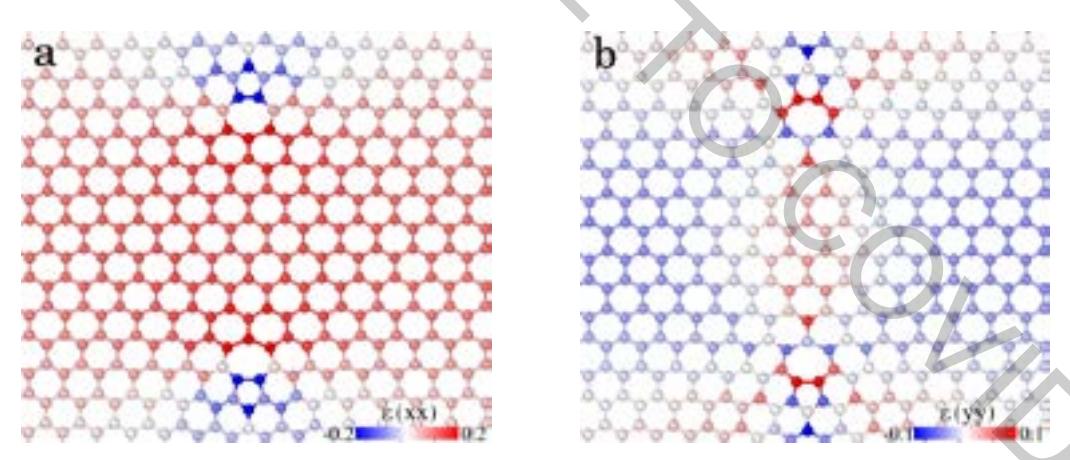
In this work, we discuss the impact of strain on optical properties of CBCN defect in hBN. Extended Tersoff potential for boron nitride systems was used to model hBN monolayers of various sizes and dislocation lengths [4]. Energy minimization calculations using the molecular dynamics package LAMMPS were performed to obtain optimized geometries. Dislocation induced strains were computed using discretisation of the deformation gradient operator. Ab-initio calculations were performed to determine the effect of strains on optical properties of CBCN defect.
We have shown that regardless of dislocation length and density, dislocation induced strains are most pronounced in the close vicinity of dislocations (up to ~ 40 lattice constants). Dislocation-induced strains give rise to strong change in ZPL energy by changing orbital overlaps between initial and final states. The observable large redshift in the ZPL of the quantum emission of CBCN is expressed as $E_{ZPL} - \Delta E (\varepsilon_{xx/yy})$, where $\Delta E(\varepsilon_{xx/yy})$ is ZPL-strain coupling parameter for CBCN in hBN, which was determined in this work. We find that strain can modify emission energy of the carbon dimer defect by up to 300 meV.