Imaging viscosity at a microscopic scale can provide information about the diffusion controlled processes in biosystems. The changes in viscosity can be an indicator of the development of atherosclerosis, diabetes, and Alzheimer's disease [1]. One of the easiest ways to image viscosity is provided by viscosity-sensitive fluorophores termed 'molecular rotors'. These fluorophores have been used in various microscopic samples, such as polymers, aerosols, model lipid bilayers, and live cells. Molecular rotors mechanism is based on a change in fluorescence signal, which arises from the competition between fluorescence and intramolecular rotation. Rotation of the molecule changes the nature of the electronically excited state leading to faster relaxation. Therefore, in a high viscosity environment the molecule stays in fluorescent state longer resulting in longer fluorescence lifetime [1].
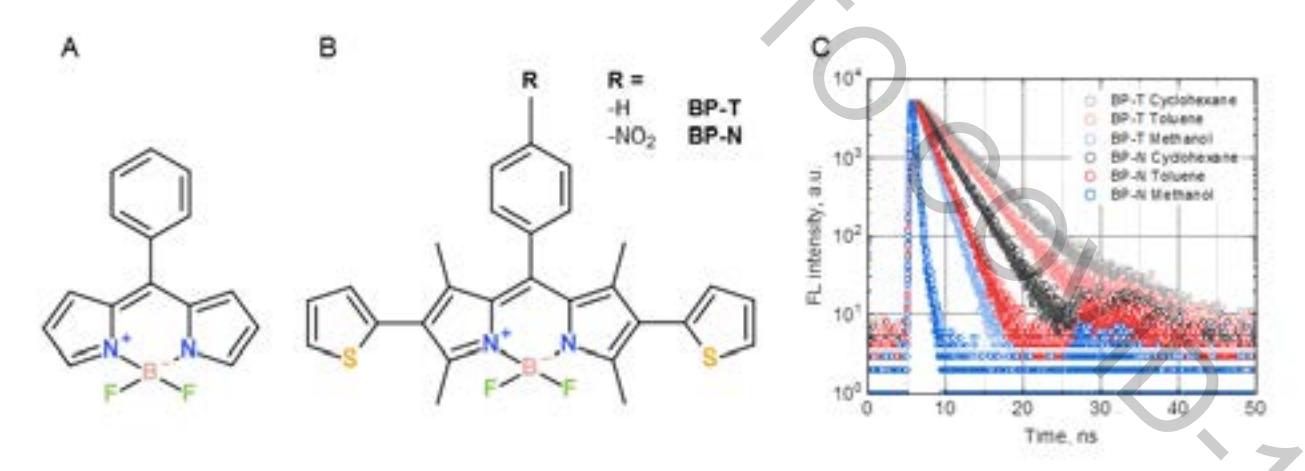
One of the most promising molecular rotors are based on phenyl substituted boron-dipyrromethene (BODIPY) structure (Fig. 1A). These derivatives have been paid much attention because of their easy functionalization, high molar extinction coefficients, and photostability. The most widely used variations are substituted with -OC10H21 and -OC12H25 [1]. Unfortunately, a great drawback of these molecules is a green fluorescence [1]. It is well known, that red and infrared wavelengths are more biocompatible because longer waves can be used in thicker biological samples, where light scattering is an issue [2]. It is possible to achieve longer wavelengths by adding thiophene group moieties, which increases conjugated system and shows a larger Stokes shift. [3] Furthermore, recently it was showed that connecting an additional nitro group to a BODIPY core improves its viscosity sensing abilities [2].
In this work, we investigate two thiophene-substituted BODIPY molecular rotors with (BP-N) and without (BP-T) -NO2 group (Fig. 1B). In this case, adding thiophene moieties in 2- and 6- BODIPY positions increases molecule's conjugation and redshifts fluorescent spectra to more biologically-friendly wavelengths. Moreover, a recent research has showed that attached thiophene moieties to the BODIPY core can rotate and this suggests that these derivatives could be sensitive to viscosity [3].
The investigation consists of absorption and fluorescence spectra measurements, as well as fluorescence lifetime evaluation in many different solvents. Dependencies regarding increasing solvent polarity, viscosity, and temperature were investigated. Spectrometry results showed that connecting a nitro group shifts absorbance and fluorescence spectra to lower energies. Moreover, it increases the Stokes shift and shortens the fluorescence lifetime (Fig. 1C).