
Membrane proteins account for 70% of all known pharmacological targets and 50% of potential new drug targets due to their direct involvement in a wide range of diseases, including diabetes, cancer and neurological disorders. As promising as the studies of membrane proteins are, it remains difficult to investigate them due to the complexity of preparation and stabilization of membrane proteins in aqueous solutions [1].
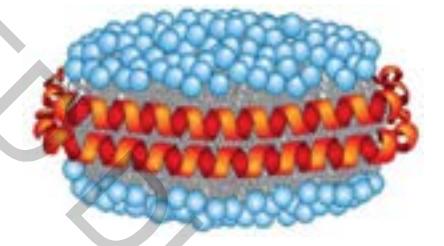
One of the most effective systems for studying the structure of membrane proteins, as well as refolding, protein-protein and protein-lipid and protein-ligand interactions, are nanodiscs – particles in the form of a flat lipid bilayer with a diameter of 8–16 nm, surrounded by a "belt" of amphipathic helices 2 polypeptide chains of the MSP protein (Membrane Scaffold Protein) [2]. Their main advantages over other methods of stabilization of membrane proteins (bicelles, flat lipid bilayer, proteoliposomes) are a clearly defined relatively small size, the possibility of embedding the monomeric form of the protein, stability in aqueous solutions, the availability of both sides of the membrane and the possibility to accurately control the lipid composition.
The following parameters of heterologous expression of MSP1 were optimized: type of producer strain, type of culture medium, time of post-induction growth. MSP1 was obtained in the standard expression system pET28(b). Since MSPs are sensitive to proteolysis, and long-term post-induction growth leads to a significant decrease in the yield of MSP, expression time was limited and the incubation temperature decreased from 37 to 28 °C after 1 hour of expression [3].
When using E. coli BL21(DE3)C41 cells as a producer strain, the cell mass yield was minimal (3.2 g of wet cells per 1 liter of culture), and when using E. coli BL21(DE3) strain, the yield of wet cell pellet was 5–6 g with 1 liter of culture medium. The cultivation of E. coli BL21(DE3) cells in 2xYT growth medium also led to a relatively low yield (2.8 g per 1 liter of culture) compared to using TB medium (5–6 g per 1 liter of culture medium). An increase in the duration of post-induction growth using 0.5 L of TB medium did not significantly affect the number of cells obtained (2.4 g, 2.5 g, 2.2 g of cells 4, 7, and 13 hours after induction, respectively). Two-step purification of MSP1 by metalloaffinity chromatography and dialysis methods yielded 1.8 mmol of protein with 1 L of culture medium. Correspondence of the molecular weight of the obtained protein preparation MSP1 was confirmed using MALDI mass spectrometry and electrophoresis under denaturing conditions.
Thus, a technique was developed to obtain the preparation MSP1, which is necessary for the reconstruction of membrane proteins. The following parameters were chosen as the parameters of MSP1 expression: type of producer strain - E. coli BL21(DE3), type of growth medium - TB medium, growth duration after induction - 4 hours. It is planned to use this technique to obtain nanodiscs with incorporated membrane proteins, in particular, CYP2 family enzymes. Reconstitution of P450 cytochromes in nanodisks will allow us to study the interactions of various CYP2C isoforms, as well as the effect of the protein environment and lipid bilayer composition on the catalytic and ligand-binding properties of enzymes of this group.