
The Large Hadron Collider (LHC) at CERN produces high energy proton-proton collisions which allow us to peek into the smallest building blocks of the Universe. Protons in the collider can be seen as streams of quarks and gluons, according to the parton model. Many different parton-parton interactions are possible during the proton collision. Probabilities of different outcomes depend on the parton distribution functions (PDFs), which describe the inner structure of the proton. Precise knowledge of the PDFs is required for realistic estimation of the probabilities of very rare events.
The Drell-Yan process is a quark-antiquark annihilation resulting in a lepton-antilepton pair [1]. High-precision measurements of the differential Drell-Yan cross section are useful for constraining the PDFs, as well as for testing the perturbative framework of the Standard Model [2]. They are also important for many other experimental measurements where the Drell-Yan process is a significant background [3, 4, 5].
Lepton tracks that emerge from the Drell-Yan process are ususally well separated from any other particle tracks produced in the event. They are called "isolated leptons." Several other processes can also lead to production of the isolated lepton pairs (for example, the leptonic decay of a top quark-antiquark pair). These processes can be easily confused with the Drell-Yan process and are referred to as backgrounds. However, non Drell-Yan production of the isolated lepton pairs is not the only possible background.
A quark or a gluon may also be produced in the proton-proton collision. Due to the confinement, it undergoes the hadronization process which results in a cone-shaped hadron stream, called a jet. Heavy flavor jets (for example, bottom or charm jets) may contain an energetic lepton. On very rare cases, some hadrons from a jet may reach muon detectors, which are located on the outermost layers of modern particle detectors, and be confused with muons. Ideally, in both of these cases the lepton track should not be isolated (it should be surrounded by a stream of hadrons). Though, it is still possible for the event reconstruction algorithm to misidentify a jet as an isolated lepton. Therefore, jet events also contribute to the Drell-Yan backgrounds.
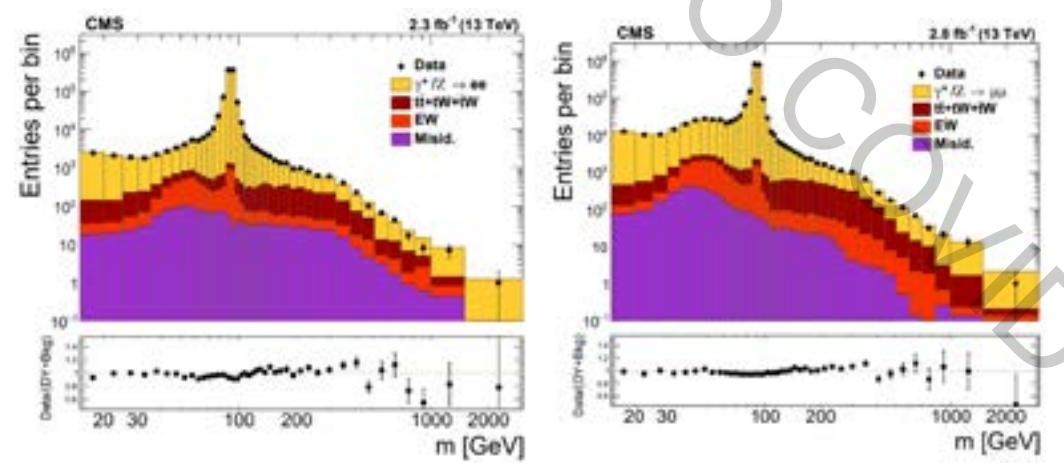
It is very difficult to predict the ammount of jet backgrounds from the simulation, because jet events have a very large cross section and a very low probability to be misidentified as isolated lepton events. Data-driven methods are used to estimate these kind of backgrounds. The fake rate method is one of them. This method relies on estimating the probability for a jet to be misidentified. The estimated probability is then used to predict the ammount of jet events in experimental data. The fake rate method and its use with the 2016 CERN CMS proton-proton collision data will be discussed in the presentation
The work is performed in collaboration with scientists from Seoul National University and University of Nebraska Lincoln. Collaboration with CERN CMS experiment is supported by Lithuanian academy of sciences.