
Chlorogenic acid, an ester of caffeic and quinic acids, is the most abundant phenolic compound that is known to have numerous biological activities such as antioxidant, anti-inflammatory, antimicrobial and anti-proliferative. This phenolic acid as the main phenolic compound in green coffee bean (GCBE) and artichoke extract (AE) can exist in the form of three different isomers, namely, i.e. 3-O-caffeoylquinic acid, 5-O-caffeoylquinic acid and 4-O-caffeoylquinic acid [1]. However, the application of caffeoylquinic acid derivatives (CQ) is restricted because of their vulnerability to heat, oxygen, light and moisture [2]. In order to overcome these disadvantages these anionic phenolics could be immobilized on cationic polymers such as chitosan (ChS).
In the present study, the formation of water insoluble complexes between ChS and phenolic compounds such as CQ, present in GCBE and AE has been investigated. GCBE/ChS and AE/ChS complexes having 0.1786 g and 0.1038 g of adsorbed GCBE and AE per of g ChS, respectively, were formed and their antifungal activity against Botrytis cinerea and Fusarium graminearum has been studied.
The CQ, GCBE and AE adsorption on ChS was investigated by employing the equilibrium adsorption method, and the Langmuir adsorption model was used to describe the adsorption isotherms (Fig. 1).
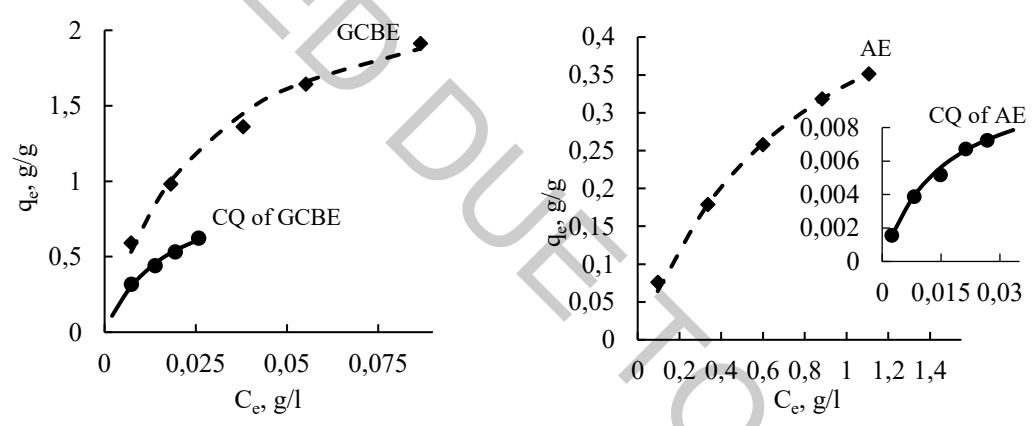
It has been estimated by UPLC-UV method that the content of adsorbed CQ was only 1.64 % and 6.12 % of the total amount of adsorbed AE and GCBE, respectively. The obtained results indicated that not only CQ derivatives but also other phenolic compounds of natural extracts have been immobilized on ChS.
It was demonstrated by growth inhibition bioassay that GCBE/ChS and AE/ChS complexes possess some antifungal activity against B. cinerea and F. graminearum strains. AE/ChS showed higher inhibition effect on mycelial growth of B. cinerea and F. graminearum when compared to GCBE/ChS (see Table 1).
| Sample | Inhibition of growth at day 4 (%) | |
|---|---|---|
| Botrytis cinerea | Fusarium graminearum | |
| AE/ChS | 50.1 | 16.1 |
| GCBE/ChS | 37.2 | 5.6 |