
Pharmaceutical wastewaters are very hazardous and toxic for the human and environmental life. Ibuprofen is among the most frequently reported active pharmaceutical ingredients in ambient monitoring studies and detected in drinking water at high concentrations (> 1 µg/L). This is due to its high consumption allied with the poor efficiency of conventional water treatment processes for its removal [1]. The aim of this work was to study the adsorption of ibuprofen from water on cross-linked cationic starch.
The cross-linked cationic starch (CLCS) microgranules were obtained by chemical modification of potato starch. CLCS was obtained by cross-linking starch with 0.1 mol/AGU (anhydroglucoside unit) of epichlorohydrin and cationization with 2,3-epoxypropyltrimethyammonium chloride. Degree of substitution of quaternary ammonium groups was equal to 0.33.
The ibuprofen (IBU) adsorption on CLCS microgranules was investigated by employing the equilibrium adsorption method. The Langmuir, Freundlich and Dubinin–Radushkevich adsorption models were used to describe the adsorption isotherms. The obtained isotherms of IBU adsorption on CLCS at different temperatures are presented in Fig. 1.
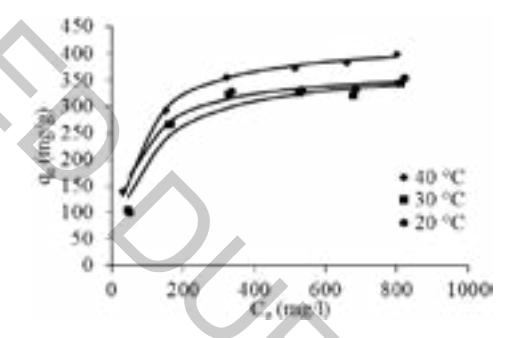
According to the Langmuir adsorption model, the IBU molecules were adsorbed on the active centers i.e. quaternary ammonium groups of CLCS. Decreasing the temperature from 40 to 20 °C the amount of the adsorbed IBU varied from 426 to 372 mg/g, respectively (Table 1). The values of Freundlich constant $n_F$ and Dubinin–Radushkevich adsorption energy $E_{DR}$ indicated that conditions for IBU adsorption on CLCS were favorable and the ion-exchange mechanism was predominant during adsorption.
| T(°C) | Langmuir model | Freundlich model | Dubinin-Radushkevich model | |||
|---|---|---|---|---|---|---|
| QL (mg/g) | R2 | nF | R2 | EDR (kJ/mol) | R2 | |
| 40 | 426 | 0.9994 | 3.17 | 0.9433 | 12.5 | 0.9686 |
| 30 | 378 | 0.9953 | 2.55 | 0.8493 | 10.5 | 0.8871 |
| 20 | 372 | 0.9969 | 2.34 | 0.8471 | 9.8 | 0.8843 |
The thermodynamic characteristics of IBU adsorption on CLCS have been evaluated (Table 2). The negative values of $\Delta G$ indicated that adsorption of IBU onto CLCS is spontaneous. The positive values of the change in enthalpy $\Delta H$ and entropy $\Delta S$ show that adsorption of IBU on CLCS was endothermic process, and the order of the system decreases during the adsorption process.
| T (°C) | ΔG (kJ/mol) | R2 | ΔH (kJ/mol) | ΔS (J/mol·K) | R2 |
|---|---|---|---|---|---|
| 40 | -7.10 | 0.9956 | |||
| 30 | -3.81 | 0.9673 | 56.32 | 201.17 | 0.8693 |
| 20 | -3.02 | 0.9727 |