
Amino acids are important body building materials. Mercapto amino acids attract considerable attention and are especially widely investigated. There are three mercapto biomolecules of the similar structure – cysteine, homocysteine and glutathione – that play crucial role in maintaining biological systems. Generally, alternations in concentration levels of biothiols in cells have been linked to a number of diseases. Therefore, detection of these mercapto biomolecules in biological samples is of crucial importance. For that purpose, a fluorescent Michael addition method for the detection of mercapto amino acids by employing a fragment of the maleimide as biothiols receptor is widely used [1]. The main goal of this project was synthesis of new dyes with a maleimide fragment, which could react selectively with mercapto amino acids and identify them.
New cyanine dyes (probes) with different number of double bonds in the conjugated chain connecting the electron donor and electron acceptor parts of dyes were synthesized [2]. Fluorescent cysteine, homocysteine and glutathione probes were prepared on their basis (Fig. 1).
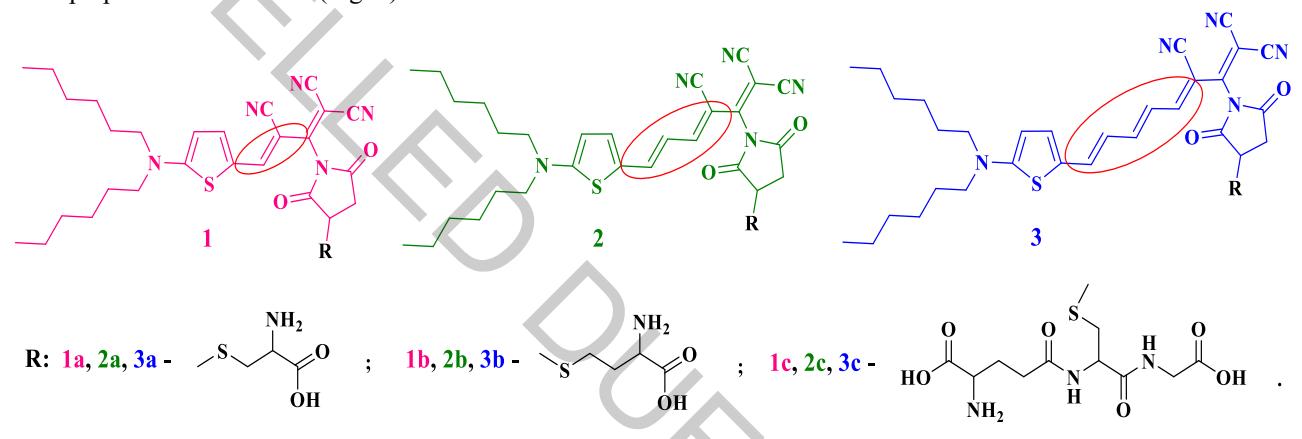
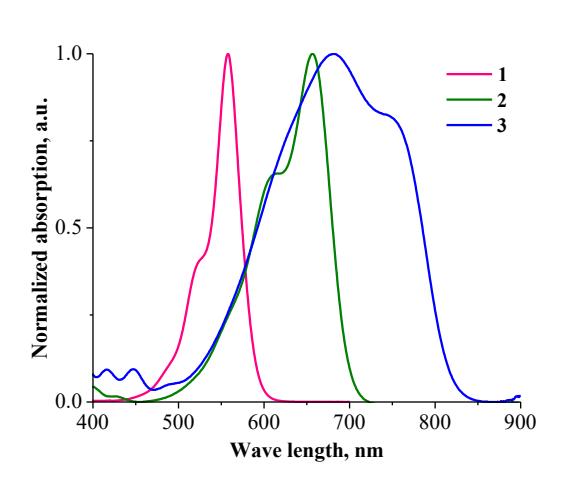
In the fluorescence spectra of the novel probes, the shifts in emission maximum have revealed that the probe 1 with the lowest number of double bonds identifies selectively all three biothiols in methanol. Based on it, fluorescent cysteine probe 1a was prepared and it showed the highest fluorescence intensity which was 6.5 times higher than that of the initial probe in dimethyl sulfoxide. The absorption maximum for the probes 2 and 3 with a longer conjugated chains of double bonds was shifted to a region of electromagnetic radiation, which is particularly attractive for identification of mercapto amino acids, i. e. 650-900 nm (Fig. 2). The probes 2 and 3 identifies selectively all three biothiols in dimethyl sulfoxide. Fluorescent cysteine probe 2a showed even better fluorescence intensity results, which were even 9 times higher in comparison with the one for the initial probe 2, whereas fluorescent cysteine probe 3a fluoresced most of all and fluorescence intensity results were even 12.5 times higher in comparison with the ones for the initial probe 3.
In conclusion, the synthesized new probes can be used successfully for the selective identification of mercapto amino acids in biological samples.