
Supercontinuum (SC) generation is one of the most spectacular optical phenomena produced by filamentation process as the intense ultrashort laser pulses propagate in transparent bulk materials [1]. SC represents extremely broadband radiation with high spatio-temporal coherence. SC generation is mainly used in production of broadly tunable femtosecond pulses in ultrafast optical parametric amplifiers [2] as well as in high repetition rate noncollinear optical parametric amplifiers [3] and more recently, in optical parametric chirped pulse amplification (OPCPA) systems [4] which employ high repetition rate (hundreds of kHz and more) and high energy ultrashort pulse lasers based on Yb-doped lasing media. The induced accumulation effects by repetitive pulse exposure may lead to the gradual degradation and even optical damage of the nonlinear material. Optimization of SC generation conditions could solve the optical degradation problems, however there are no consistent studies on early indications and evolution of the optical damage at high repetition rate condition.
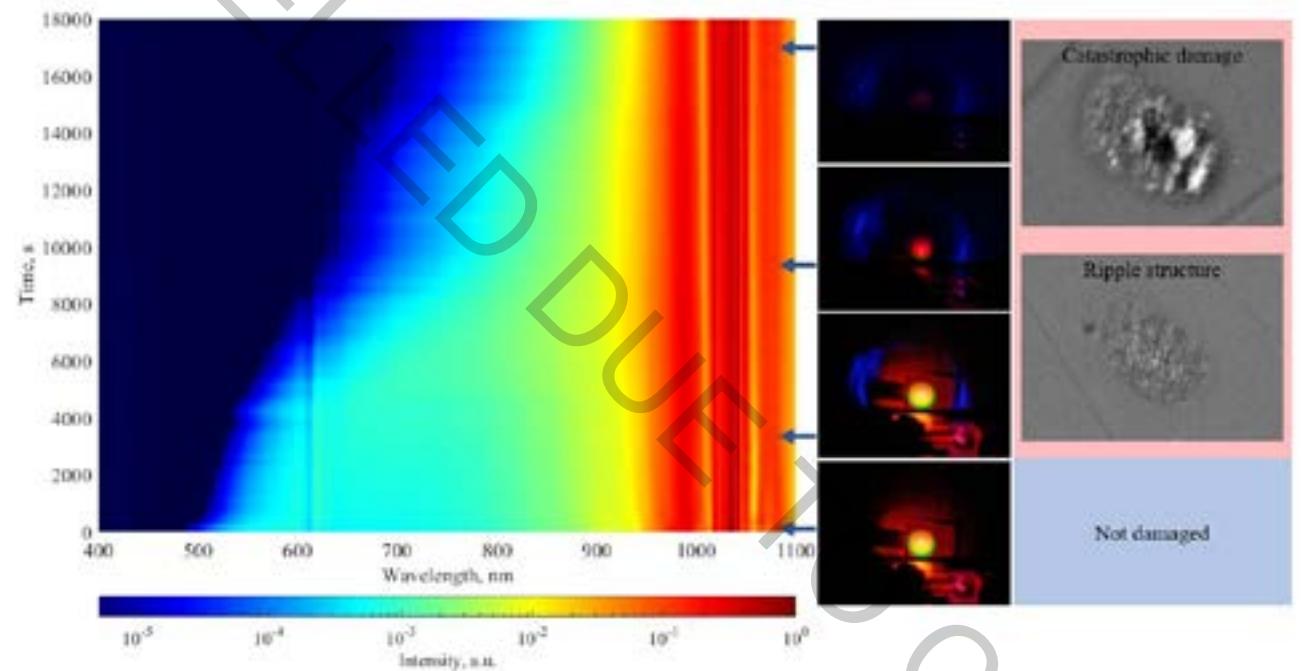
The aim of our study was to experimentally investigate the SC generation and optical degradation effect in sapphire and YAG nonlinear crystals at high laser pulse repetition rates and provide some practical guidelines on SC application at these conditions. During the experiments the nonlinear materials were irradiated with 1030 nm, 180 fs pulses from an amplified Yb:KGW laser varying the laser repetition rates from 2 kHz to 200 kHz and beam focusing conditions from tight (NA=0.085) to loose (NA=0.025). The time evolution of the SC spectrum, changes in filament-induced luminescence and third harmonic generation due to damage formation were investigated (Fig. 1). We found that the optical damage is initiated in the bulk of the nonlinear crystal at the nonlinear focus of the pump beam in the form of the ripple structure. As the early indicator of optical degradation process is third harmonic diffraction from this ripple structure which correlates with the shrinking of the SC spectrum. We believe that these results could provide a better practical understanding on how to optimize SC generation in bulk materials at high repetition rates.