
For the last few decades there has been a growing interest in applicable lead-free materials [1]. Due to environmental concerns the lead-free piezoelectric material research has grown significantly. As most commercially viable piezoelectric materials with lead have great piezoelectric constant and can operate in a broad temperature range, the aim of this research is to improve dielectric and piezoelectric properties in lead free solid solutions.
Nanocomposite ceramics have been making a breakthrough in search for piezoelectric materials. In this case the material is a "core-shell" type nanocomposite ceramic that consists of a BT-BMT crystallites cores which are coated in a BT shell.
BT-BMT/BT "core/shell" composites were prepared in two steps: the BT-BMT solid solution core was mixed with TiO2 crystallites in a high pressure compressor into cylindrical shape pellets [2], [3] and then submerged into barium hydroxide solution at 175 °C for solvothermal solidification [4], [5].
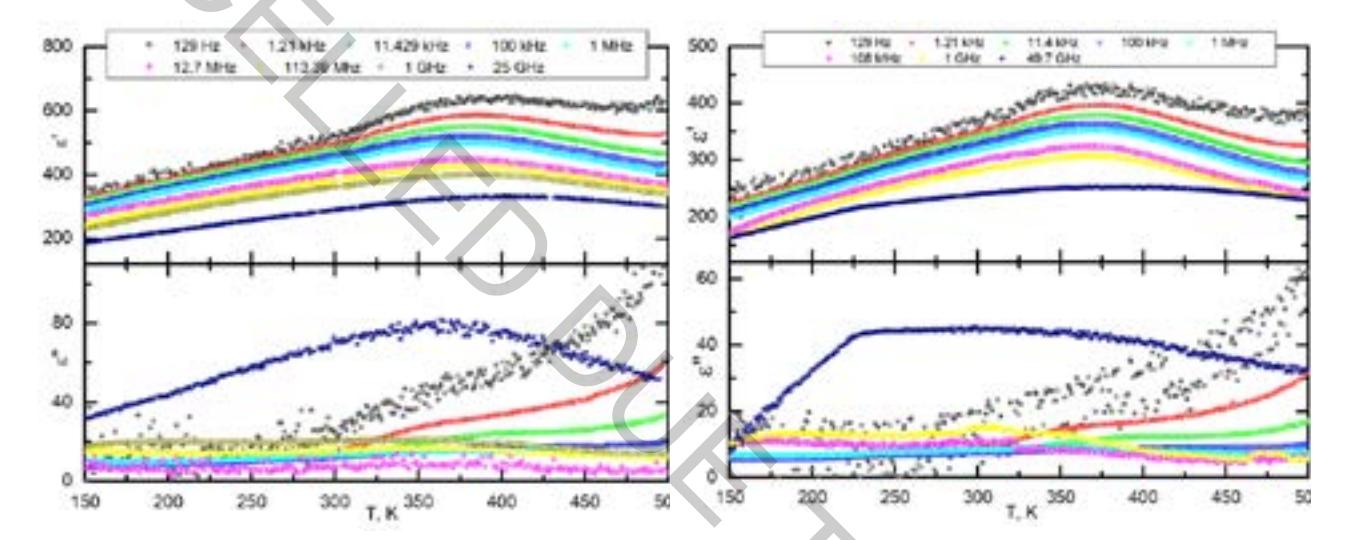
In figure 1 we can observe an complex dielectric permittivity of (1-x)BT-xBMT/BT where x=0.4 (left) and x=0.3 (right) "core/shell" solid solutions an anomalous dielectric constant close to 395 K temperature in x=0.4 ceramic can be seen. Adding a little bit of BT x=0.3 into the system shifts the anomaly toward lower temperature range by 20 K. This dielectric constant peak could be linked to a structural phase transition.
The dielectric constant dependence of temperature seems similar in both solid solutions. The value of dielectric constant is lower, however there seems to be an increase of dielectric permittivity in lower frequencies and high temperatures.
In the poster presentation further investigation would be presented as the 0,6BT-0,4BMT/BT solid solution would be compared to 0,7BT-0,3BMT/BT composite.