
Nowadays, great attention is paid to the search for new materials based on wide-gap oxides, as well as to studying their structure and properties for the purpose of application in various areas of the radioengineering, electronics and optoelectronics [1, 2]. However, the influence of doping on electric properties of such widely known oxide as ZnO, obtained by ceramic technologies, are not fully understood. The aim of this work is to study interconnection between electric properties (resistivity, Seebeck effect) and phase structure of doped ZnO-based ceramics.
In the ceramics studied, we used powder mixtures (MO)-(ZnO) with different its relations, where MO = Al2O3, NiO, TiO2, CoO, after uniaxial pressing and one-step annealing for 3 hours at 1200 °C. The intial powders were either commercial or prepared by technology of sol-gel synthesis.
It was revealed that, when using the sol-gel synthesis for preparation of initial powders, the size of the microparticles in the ZnO-based ceramics decreases slightly after annealing. As is seen from Fig. 1a, additions of MO powders did not change wurtzite type of crystal lattice in ZnO-based solid solutions but forms after annealing new extra phases of ganite ZnAl2O4 [3] and zinc orthotitanate Zn2TiO4 [4] with spinel structure for MO = Al2O3, TiO2. At the same time, addition of CoO did not result in the formation of extra phases.
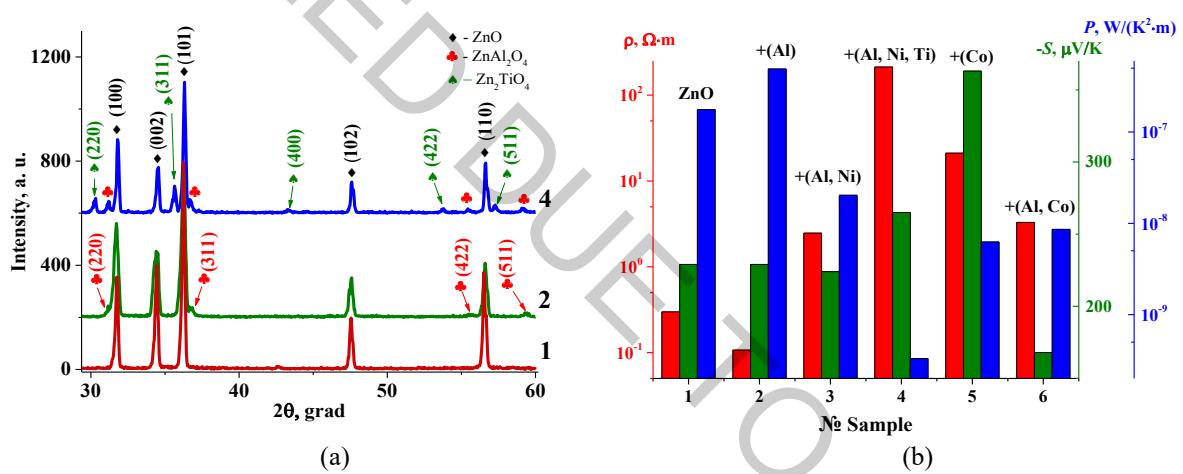
In the annealed ceramics with 50 wt. % CoO (sample 5 in Fig. 1b) resulted in increase of Seebeck coefficient S although simultaneous addition of small amounts of CoO and Al2O3 (sample 6 in fig. 1b) oppositely suppressed S values 4 times and increased resistivity twice. Addition of 3 wt. % of Al2O3 decreased resistivity 4 times and practically did not change S (sample 2 in Fig. 1b). At the same time, additions of app. 19 wt.% of TiO2 simultaneously with Al2O3 (2,8 wt. %) and NiO (0,4 wt. %) strongly increased resistivity, but only slightly changed S values (samples 3 and 4 in Fig. 1b). As is seen, the electrical resistivity $\rho$ increases with the addition of cobalt, titanium and nickel oxides, which negatively affects the value of the power factor P due to dielectric properties of metal oxides [5].