
Caffeic acid (CA) is hydroxycinnamic acid derivative, with antioxidant, anti-inflammatory, and anticancer activities. However, the application of CA is restricted because of its readily oxidation, low bioavailability, sensitivity to heat, light and moisture. In order to overcome these disadvantages this anionic phenolic compound could be immobilized on cationic polymers such as cross-linked cationic starch.
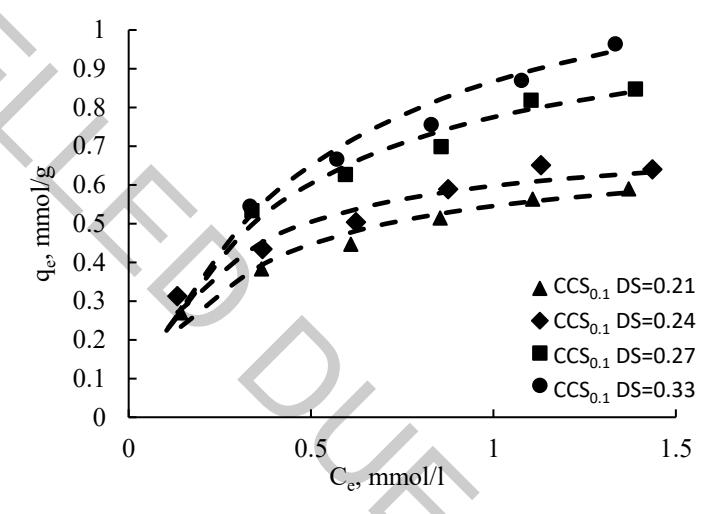
In the present study, the equilibrium adsorption of CA on cross-linked cationic starch (CCS) derivatives with different degree of substitution (DS) of quaternary ammonium groups was investigated. The Langmuir, Freundlich and Dubinin-Radushkevich adsorption models were applied to describe the adsorption isotherms of CA (Fig. 1, Table 1).
| Adsorbent | Langmuir model | Freundlich model | Dubinin-Radushkevich model | |||||
|---|---|---|---|---|---|---|---|---|
| $Q_L$ (mmol/g) | $K_L$ (1/mol) | EF | $R^2$ | $n_F$ | $R^2$ | $E_{DR}$ (kJ/mol) | $R^2$ | |
| CCS0.1 DS=0.21 | 0.70 | 3488 | 0.65 | 0.9918 | 2.85 | 0.9978 | 11.8 | 0.9980 |
| CCS0.1 DS=0.24 | 0.73 | 4368 | 0.61 | 0.9936 | 2.95 | 0.9948 | 12.2 | 0.9893 |
| CCS0.1 DS=0.27 | 1.08 | 2510 | 0.81 | 0.9845 | 3.08 | 0.9924 | 12.0 | 0.9863 |
| CCS0.1 DS=0.33 | 1.30 | 1993 | 0.84 | 0.9911 | 2.44 | 0.9984 | 10.7 | 0.9959 |
According to the Langmuir adsorption model, CA was adsorbed on the active centres of CCS, i.e. on the quaternary ammonium groups. The driving forces of adsorption were interactions between these groups and carboxylic groups of phenolic acid. As could be seen, with the increase of DS of CCS the values of the Langmuir sorption capacity $Q_L$ and adsorption efficiency EF increased. Meanwhile, the calculated values of Dubinin-Radushkevich adsorption energy $E_{DR}$ confirmed that CA was adsorbed by ion exchange mechanism and values of Freundlich constant $n_F$ showed that conditions for CA adsorption on all CCS derivatives were favourable.