
During the long time meteorites were the only source of information about the protoplanetary and early planetary history of the Solar System. Nowadays, despite of the intensive development of space research, meteorites remain the key source of the above-mentioned information. The studies of mineral and chemical composition of meteorites expand our knowledge of the Solar System cosmogony [1-4]. According to the mineralogical and chemical composition, all meteorites are divided into three groups: stony, stony-iron, and iron meteorites. The stony-iron meteorites consist of nearly equal parts of iron and stone (silicates). The stony-irons are divided into two classes: mesosiderites and pallasites. Their main difference is following: the mesosiderites' silicates are mainly represented by pyroxene and plagioclase, and the pallasites' silicates are olivines of various sizes and shapes.
The Brahin meteorite represents a group of fragments that were found over 200 years ago in the Brahin District (former Russian Empire, now Belarus). All fragments have the same structure and composition. Despite of long history of the Brahin meteorite, it remains poorly studied [1].
The olivines are the most common minerals in the Brahin meteorite. They visually compose approximately 50% of the plate area of the Brahin meteorite. The second most common mineral is the nickel iron, which accounts for approximately 45% of the plate area.
The main goal of this work is studying of the mineral composition of the stony part of the sample of the Brahin meteorite. The local spatial and volume distribution of the elements was determined by laser multichannel spectrometry using the laser atomic emission multichannel LSS-1 spectrometer, which has the following characteristics: the pulse duration is around 15 ns, the laser radiation is focused on the sample using an achromatic condenser with a focal length of 104 mm, the size of the focus spot is approximately 50 μm, the pulse energy is 35 mJ.
The Fig. 1a represents a portion of the stony part of the meteorite. The places of the double laser pulses impacts are the black dot in the light part, and the white one in the dark part. Figs. 1b and 1c show layer-by-layer (20 pulses per layer) distribution of Mg, Ca, and Fe in the indicated points.
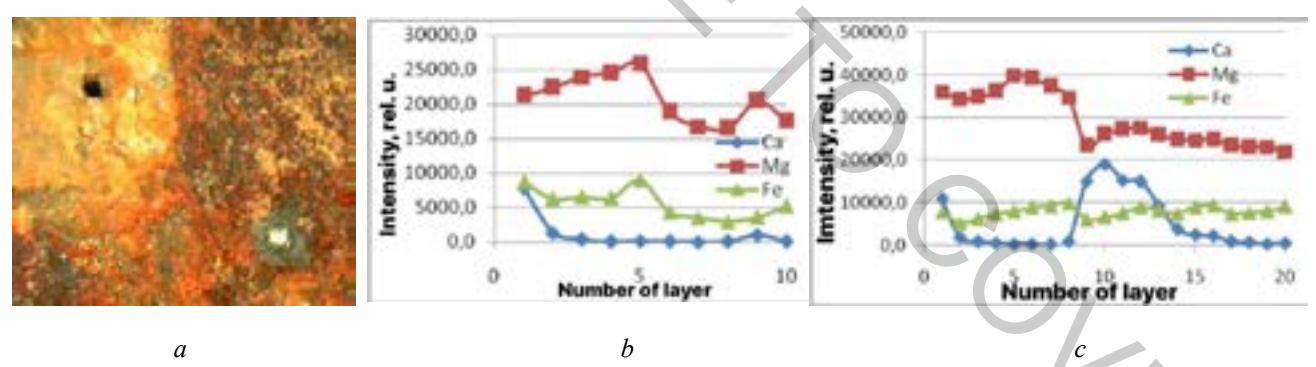
There is a significant difference between distributions of Ca in the light and the dark parts of the meteorite. It can be assumed that there is an inclusion of a new mineral in the dark part at the depth between 9th and 15th layers. Taking in the account the fact that the average ablation per pulse is of the order of 10-15 μm, the thickness of the mineral sample is approximately 50-150 μm. To assess the size of the inclusion, the analysis of the calcium content was made in two mutually perpendicular directions. The approximate size of the inclusion is 1×1.3 mm.
It should be worth mentioned that earlier (see, for example, the most detailed study of the chemical and mineral composition of the stony part of the Brahin meteorite [1]) the presence of a mineral containing together these three elements was not found. Apparently, the mineral belongs to a variety of Ca-containing olivines [4].