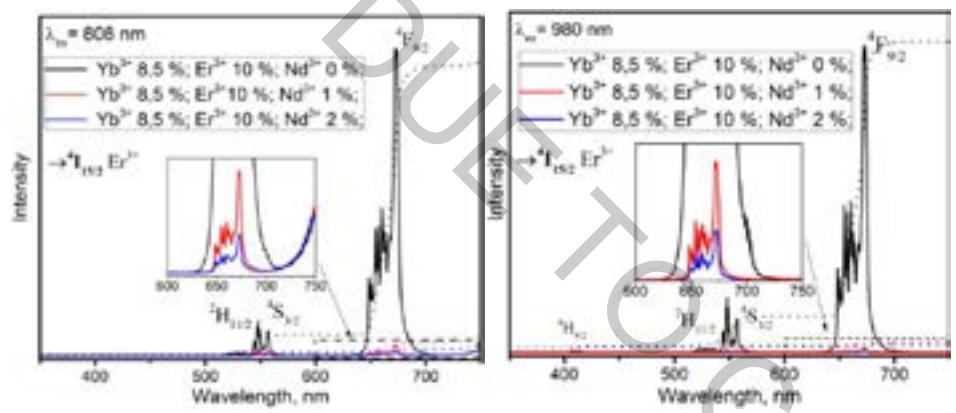
Upconverting phosphor materials are attracting considerable attention for their possible applications in solar cells with improved efficiency or as safety ink, nanomaterials for bio-imaging, lasers and novel display technologies [3]. Upconversion materials consists of inorganic host lattice doped with lanthanide ions, can convert low-energy incident radiation into higher energy emitted radiation. Upconversion refers to non-linear optical processes characterized by the successive absorption of two or more excitation photons via intermediate long-lived energy states followed by the emission of a shorter wavelength photon than the excitation [1]. Up to now, reported upconversion efficiencies have been relatively low, excitation thresholds quite high, and the investigated phosphors (generally fluorides) often presented poor chemical stability (hygroscopy), limiting their industrial applicability [2]. Y2BaZnO5 can be an excellent host material for doping with lanthanide ions. It has good chemical, physical properties and is stable at high temperature [3,4].
In this work, Er3+, Yb3+ and Nd3+ co-doped orthorombic Y2BaZnO5 phosfors were synthesized via high temperature solid-state method. Pure phase Y2BaZnO5 synthesized by 4 stages of heating. A variety of dopants, including Er3+, Yb3+ and Nd3+, were embedded in the host lattice, resulting in bright red and green light emissions under 980 nm excitation and at relatively low excitation powers. Thermal stability of synthesised Y2BaZnO5 were measured by X-ray diffraction after heating sample at high temperatures for 24 hours. There was no other phases after heating the same Y2BaZnO5 sample at 300 °C, 600 °C and 950 °C for 24 hours in all temperatures.