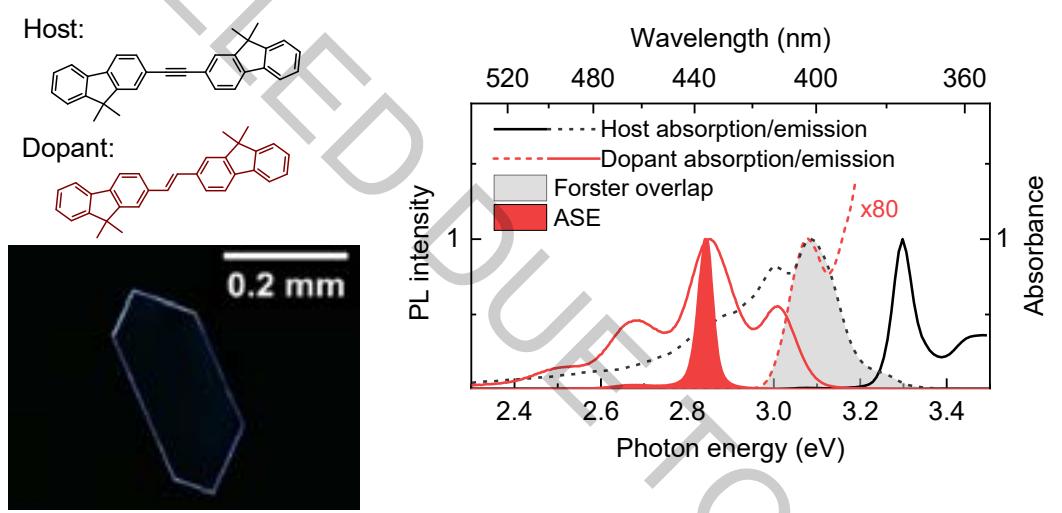
Organic single crystals with long-range molecular order ensure high carrier mobility, enhanced photochemical and thermal stability as well as negligible light-scattering, what makes them attractive as an optical gain medium for electrically-pumped organic lasers [1]. Unfortunately, strong coulombic interactions between molecules (i.e. excitonic coupling) in crystals introduce losses degrading optical performance in crystals, hence higher lasing thresholds are observed compared to amorphous films. Bifluorene crystals were already proved as a successful gain materials [2-5]. Here, excitonic coupling in bifluorene was assessed by spectroscopic methods. Furthermore, crystal doping strategy is investigated as a method to avoid pronounced reabsorption and annihilation losses associated with J-type excitonic coupling, while taking advantage of enhanced exciton transport for efficient energy transfer (Fig. 1). Bifluorene-based derivatives linked with acetylene and ethylene rigid bridges are suitable as host and dopant system forming high-quality doped crystals. Amplified spontaneous emission (ASE) threshold down to 1.1 μJ/cm2 was enabled by minimized exciton annihilation and emission reabsorption losses.