Energy losses determined by radiation of impurities in various ionization stages have to be controlled for the successful ignition of a deuterium-tritium plasma in thermonuclear reactors. Ionization balance in the plasma is mainly established by electron-impact ionization and recombination processes. Such processes have to be well understood for predicting possible plasma scenarios.
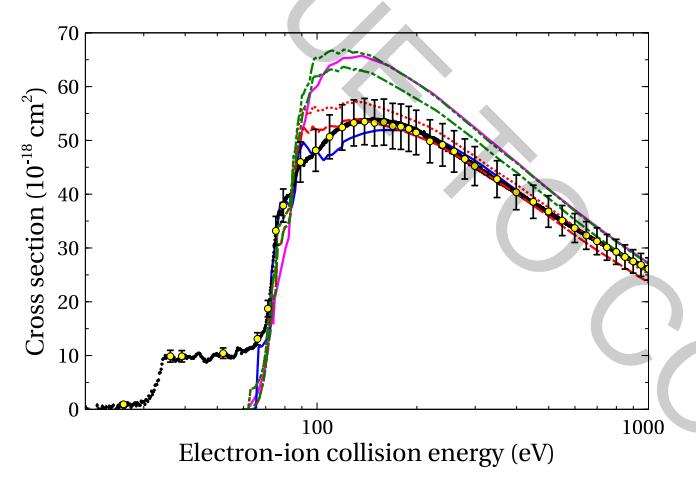
The main goal of the current work is to present theoretical study of electron-impact single ionization cross sections for the W5+ ion. The theoretical study includes direct and indirect processes. Level-to-level calculations were performed for the 5d ground configuration and for several excited configurations of W5+. For all contributions considered in the determination of the total single-ionization cross section, autoionization branching ratios for every level of the W5+ ion populated by excitation of one of the initial states were calculated accounting for Auger and radiative decays from the level.
The Flexible Atomic Code (FAC) [1], which employs the Dirac-Fock-Slater method, is used to calculate energy levels, radiative and Auger transition probabilities, and electron-impact excitation and ionization cross sections. The cross sections are obtained in the distorted wave (DW) approximation. Excitations of the 4f, 5s, 5p, and 5d electrons from the 5d, 6s, 4f135d2, 5p55d2, and 4f135d6s configurations up to the shells with n = 12 are taken into account in the study to ensure convergence of the EA data. Furthermore, the excitations to all subshells with orbital quantum numbers $l \le 6$ are studied. It can be seen that there is a difference of ~20% between the n = 7 and the n = 12 result at the peak of the cross section (Fig. 1). Radiative damping of the autoionizing states leads to diminishing of the total ionization cross sections by ~14% at the peak.
The influence of initial- and final-state correlation on electron-impact ionization cross sections from the ground configuration is investigated. Correlation is taken care of by the implementation of configuration interaction applying suitable basis sets. The correlation effects are studied for the strongest DI channels and excitations that lead to single ionization. The configuration interaction strength (CIS) [2] is employed to determine a list of admixed configurations having the largest influence on the configuration under consideration.