
The increased contamination of aquatic environment and water resources by industrial activity became a serious threat to the sustainability of society [1, 2]. The ineffectiveness of traditional mechanical and biological water treatments to remove some specific organic compounds, such as parabens, requires to search for new ways to eliminate these contaminants.
The aim of this research was to study the binding of metilparaben to starch acetate sorbent in water.
Starch acetate (SA) microgranular sorbent (degree of substitution of acetic groups was equal to 0.34) was obtained by reacting anhydroglucoside unit of starch (AGU) with acetic anhydride (AA) using 50% aqueous NaOH as the catalyst for 4 h at 125°C (the molar ratio AGU : AA: NaOH was 1 : 6.36: 2.75).
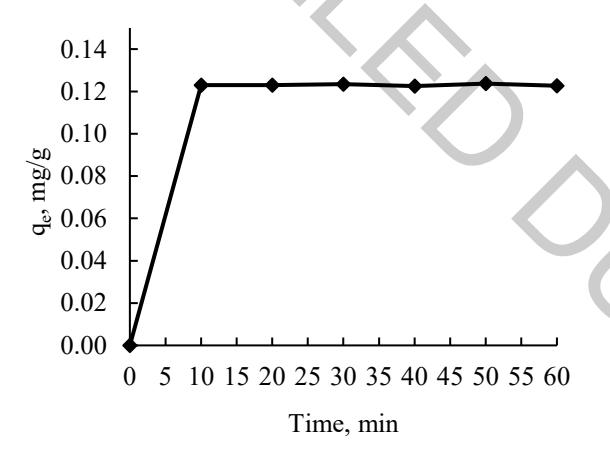
The adsorption kinetics of MP on SA was investigated (Fig. 1). The adsorption kinetics showed that the adsorption equilibrium is practically achieved within 7 min. To achieve complete equilibrium, the experiment was extended to 30 min.
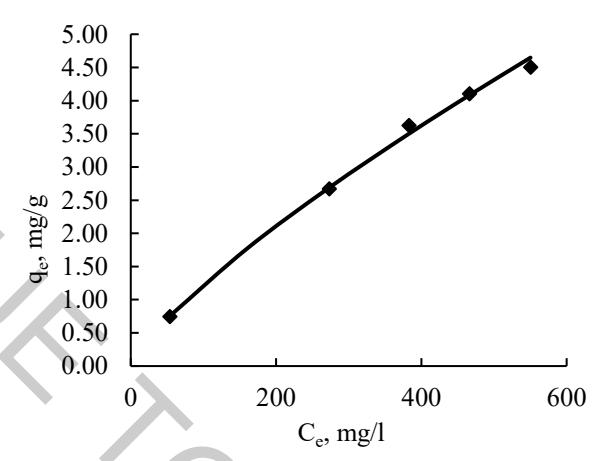
The metilparaben (MP) was partially removed from water by adsorption on SA microgranules. The Langmuir, Freundlich and Dubinin–Radushkevich adsorption models were applied to describe the adsorption isotherms of MP (Fig. 2, Table 1).
| Langmuir model | Freundlich model | Dubinin-Radushkevich model | ||||
|---|---|---|---|---|---|---|
| QL, mg/g | KL, 1/g | R2 | nF | R2 | EDR, kJ/mol | R2 |
| 10.19 | 32791 | 0.9654 | 1.28 | 0.9989 | 7.2 | 0.9987 |
The values of $R^2 > 0.99$ support the fact that the adsorption of MP closely follows the Freundlich adsorption model. The value of the Langmuir sorption capacity $Q_L$ showed the amount of MP adsorbed at equilibrium, i. e. 10.19 mg/g. The calculated values of Dubinin-Radushkevich adsorption energy $E_{DR}$ indicated that MP was adsorbed due to physical forces, possible because of hydrophobic properties, and values of Freundlich constant $n_F$ showed that conditions for MP adsorption on SA were moderately difficult.