Over the past decades, the production of spinel ferrite nanoparticles has been intensively studied due to their promising magnetic properties. Cobalt ferrite ($CoFe_2O_4$) is especially attractive because of its high coercivity and moderate saturation magnetization. It was shown that substitution of $Co^{2+}$ with $Zn^{2+}$ leads to enhanced magnetic properties of nanocrystalline ferrites [1]. Zinc substituted cobalt ferrites are considered to be suitable magnetic materials for such applications as magnetic drug delivery [2], magnetic resonance imaging, information storage system, ferrofluids [3], etc.
Our study is devoted to improvement of ultrasonic spray pyrolysis (USP) technique in order to enhance magnetic properties of ferrite nanoparticles. It's generally known that increasing crystallinity of magnetic nanoparticles leads to the increase of saturation magnetization. Therefore, the main aim of this research is to increase nanoparticle's crystallinity by calcination at high temperatures. At first, cobalt-zinc ferrite suspension was prepared by co-precipitation from a solution of metal nitrates taken in stoichiometric amount. Sodium chloride (wt. concentration 5: 1 with respect to ferrite) was added to the suspension to prevent aggregation and sintering during calcination. Magnetic nanoparticles were obtained from as-prepared suspension by USP method at 600°C. Thus, cobalt-zinc ferrite nanoparticles in inert matrix were synthesized. Finally, calcination was carried out within temperature range from 300 to 900 °C in order to improve crystallinity.
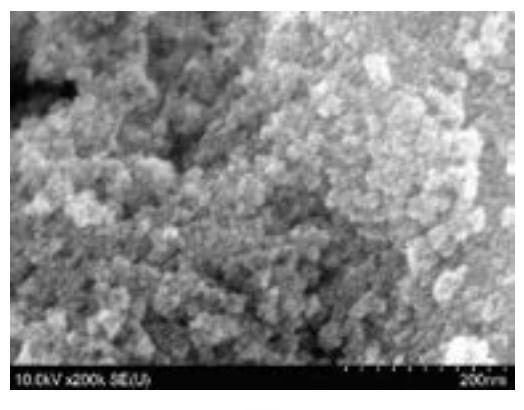
The phase composition and structure of ferrites were studied by XRD and FT-IR spectroscopy. The size and morphology of the particles were examined by SEM, saturation magnetization of samples was measured by SQUID magnetometry. The average size of nanoparticles annealed at 300°C is about 7 nm (Fig.1). It was found that significant growth of those occurs during annealing process at 900°C. Nevertheless, major fraction of the particles remained within nanoscale range (about 80 nm) although recrystallization process caused formation of the larger particles fraction (200 nm and higher). The calculations of the crystallite size based on the diffraction reflection broadening correlate to average size data obtained from SEM. The average crystallite size was found to be 53 nm for annealing at 900°C, 7 nm –at 300°C. With increasing annealing temperature from 300°C to 900°C saturation magnetization increased from 45.0 emu/g to 78.6 emu/g. (Table.1)
| T, °C | 900 | 700 | 500 | 300 |
|---|---|---|---|---|
| Ms, emu/g | 78,6 | 54,7 | 45,6 | 45,0 |