
Currently, much attention has been paid to the study of the influence of acoustic waves on the combustion of various fuel types [1]. Combustion of solid fuels under the influence of sound waves is less studied and needs to be further researched. The purpose of this work is to study the effect of an external low-frequency acoustic field on the combustion of hexamine C6H12N4. See Fig. 1(a).
An experimental setup consisting of a functional sound generator, an acoustic speaker, a resonator chamber, and a granite platform for placing a combustible body has been designed. The range of oscillation frequencies produced by the speaker was 1 – 12.500 Hz.
It was found during the first set of experiments that hexamine combustion is being extinguished with external acoustic waves of v = 80 Hz frequency.
The second set of experiments, conducted without a resonator chamber, showed that when a burning hexamine sample was impacted by sound waves with a frequency of v = 80 Hz, its combustion time decreased on average by 16%. The sample weight varied from 0.5 to 2.5 gr. See Fig. 1(b).
During the third set of experiments, the dependence of the sample complete burning time on the frequency of sound waves (60 – 800 Hz) was evaluated. See Fig. 1(c).
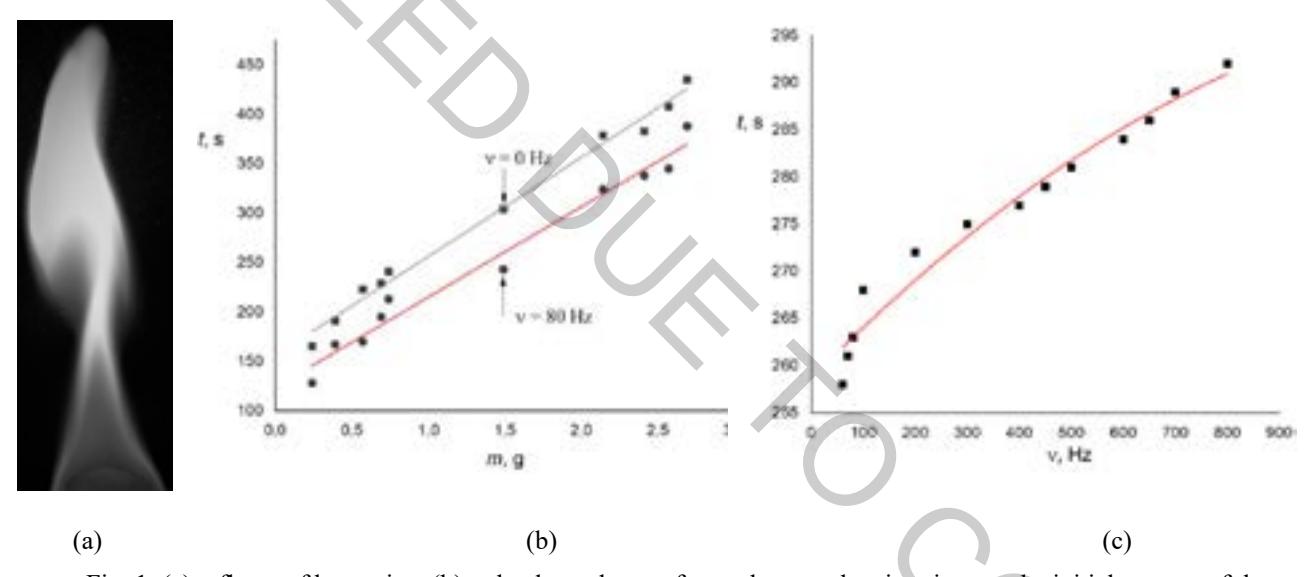
The influence of external sound waves on the combustion process is presumably explained by the fact that periodically acting acoustic waves remove the combustion products formed in the external part of the flame torch, thereby contributing to the influx of new air into the working mixture.
Obtained results will find applications in extinguishing of small localized fires that can happen in electronic sensors and controllers.