
Nanocomposite is a multiphase composite system, consisting of several materials with various structure and with a characteristic size about a nanometer. If a number of nanoparticles are located nearby, and they don't have a phase separation boundaries, they could be grouped in cluster with common properties.
Standard site percolation model assume that each vertex is conductive with a probability $P_{cond}$ or non-conductive with probability $P_{noncond} = 1 - P_{cond}$, all edges are conductive with probability $P_{conn} = 1$ and there no phase separation boundaries. In real nanocomposites, however, there are oxide shells around metallic cores that can prevent the formation of electrical contact even if nanoparticles are close together[1]. To model such a system we augment site percolation model to consider located probability of breaking bond between particles $P_{ox}$, described as a result of metal core oxidation. This illustrates is a nanocomposite, consisting of conductive internal core and perforated insulating shell.
The developed model demonstrates dependency of system conductivity probability $P_s$ as a function of two parameters $P_s = f(P_{cond}, P_{ox})$. Percolation threshold probability $P_c$ determines depending on $P_s$ graph view, so $P_c = f(P_{cond}, P_{ox})$ too.
Fig. 1a illustrates $P_s$, where each curve on a graph is $P_s = f(P_{cond})$ with different constant $P_{ox}$ ($P_{ox} = const$). Fig. 1b is an example of generated nanocomposite clusters, used for conductivity probability statistic.
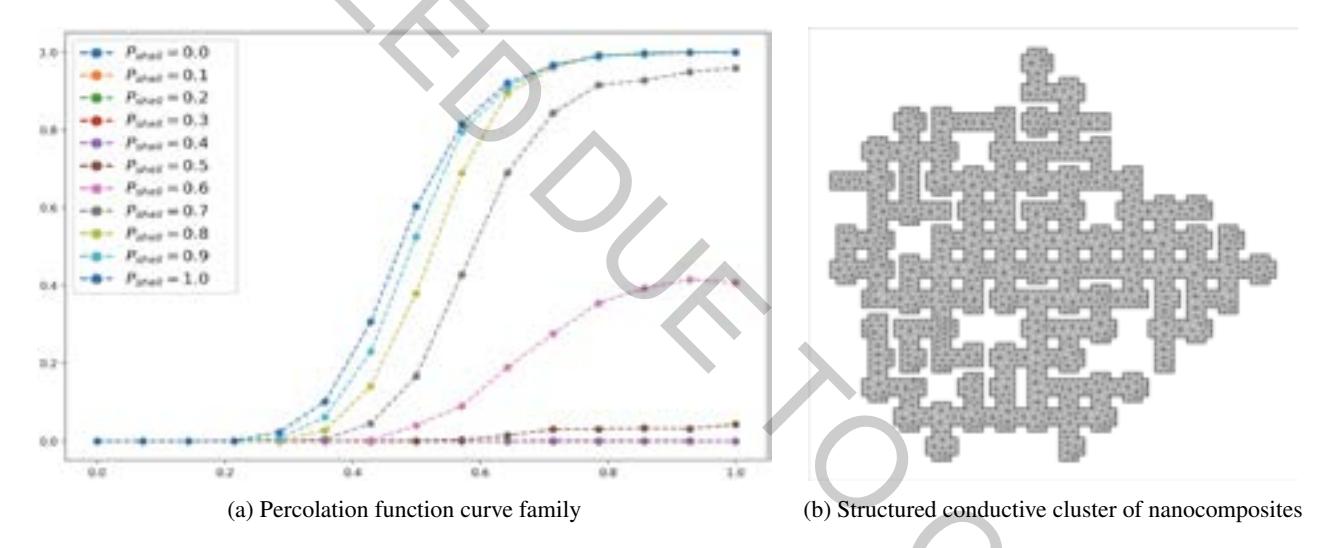
If $P_{cond} = 1$, this model becomes a percolation of connections only, but when $P_{conn} = 1$, it is a percolation of nodes [2]. Experiments confirm that with $P_{conn} = 1$, $P = 0.59$.
To generate percolation cluster could be used Hoshen-Kopelman algorithm [3]. But this algorithm could not be used for the generation of system on grid with node count $N_{node} > 1000$. To boost calculation performance, we used a corn-generation method. In the center put a conductive node (corn), nodes around corn marked as a possibly conductive too. Each marked node with $P_{cond}$ became conductive or with $P_{noncond}$ marked as nonconductive. It repeats while possibly conductive node list is not empty. For each conductive node with shell conductivity probability $P_{shell} \in [0,1]$ could be added shell. Nearby nodes are connected if both have a shell from symmetrical side. If conductive cluster diameter $d_{cluste}$ greater than environment size $L_{env}$, system considered conductive.
Next step will be research of conductivity of such cluster and calculation of energy flow throw shell-considered model.