
Tin selenide films are valued for such properties as non-toxicity, financial availability and good optical properties, which depend on tin selenide structure (Table 1). It is known that different tin selenide forms have different bandgap value, for example, direct bandgap value for tin selenide nanocrystals is 1.71 eV and for monolayers – 1.66 eV [1].
| Structure | Direct bandgap, eV | Indirect bandgap, eV |
|---|---|---|
| Bulk | 1,3 | 0,9 |
| Nanosheets | 1,10 | 0,86 |
| Nanocolumns | - | 0,93 |
| Nanocrystals | 1,71 | - |
| Single layer | 1,66 | 1,63 |
| Double layer | 1,62 | 1,47 |
Nowadays great attention is given to use this tin selenide films as semiconductive layers in solar cells systems. These layers have a potential to replace such materials as gallium telluride (direct bandgap value – 1.65 eV) or gallium arsenide (direct bandgap value – 1.55 eV), which are now used in second generation solar cells structures. Also, it is known, that doping of primary semiconductive layer has an ability to chance its optical parameters [2, 3].
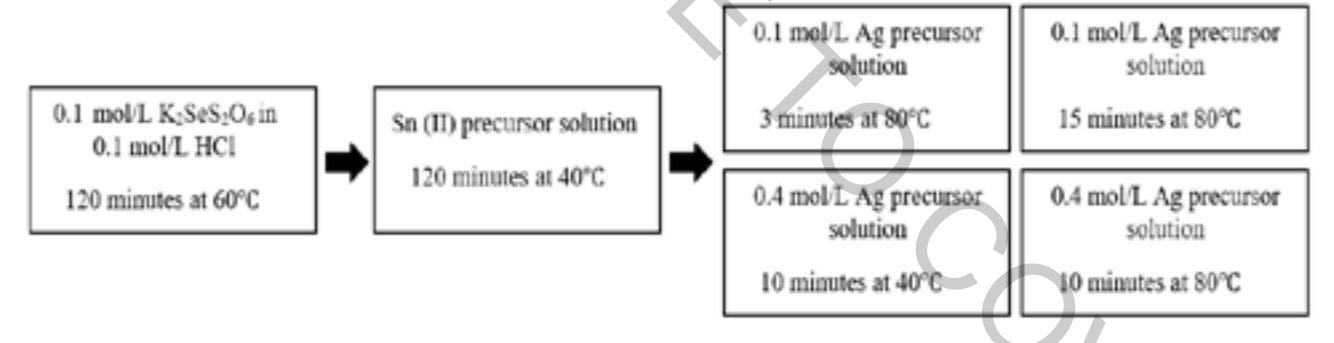
In this work was investigated how different concentration of silver dopants change primary tin selenide layers bandgaps values. All layers were formed by using simple and cost-efficient sorption-diffusion method. During this method polyamide 6 sheets are immersed into precursors solutions as it is shown in figure 1.
Optical properties and quantitative analysis of the obtained layers were investigated by UV/VIS spectroscopy and atomic absorption spectroscopy. These analyses indicate that with increasing of silver dopants concentration the bandgap value of primary tin selenide layer decrease.