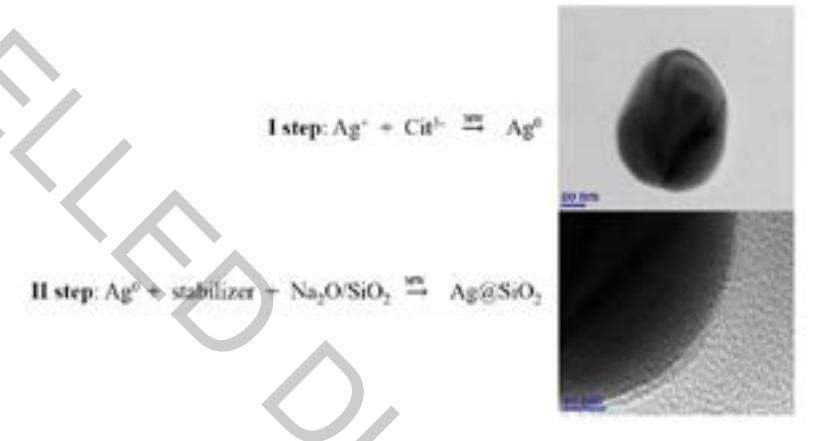
The silica shell-isolated nanoparticles spread over the surface of sample material are widely used in various fields such as nanoelectronics, biomedicine or environment science. Shell-isolated nanoparticle-enhanced Raman spectroscopy (SHINERS) is one of the most powerful tool to investigate various materials with diverse morphologies [1]. Typically, such nanoparticles are prepared by reduction with sodium citrate in boiling aqueous medium [2]. We have successfully modified the most used synthesis protocol [2, 3] and applied it for microwave synthesis (Fig. 1). This more convenient, efficient, fast method of synthesis allows to obtain $90 \pm 5$ nm size silver nanoparticles with 3 nm of silica shell (Ag@SiO2).
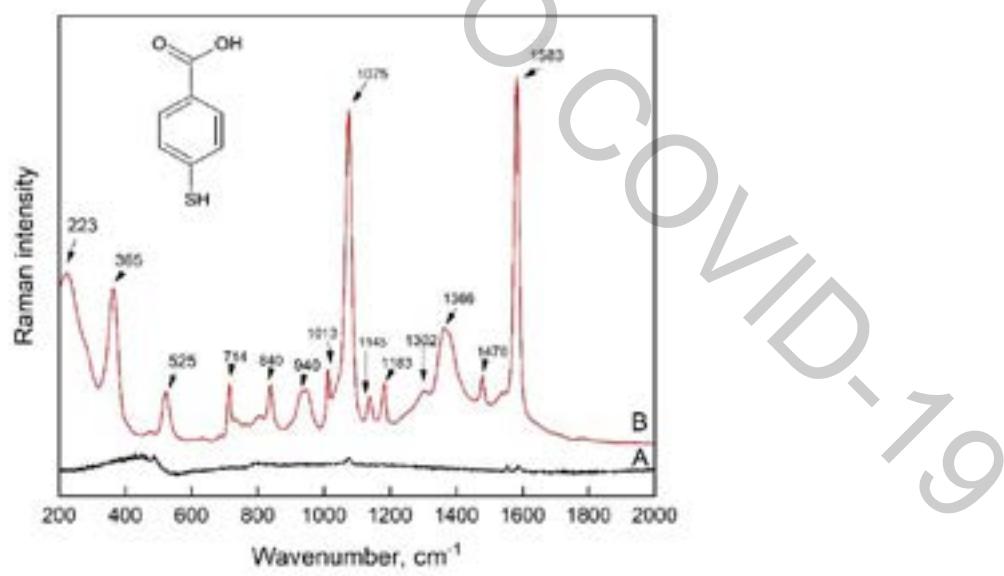
In order to show that synthesized Ag@SiO2 nanoparticles enhance Raman signal, a self-assembled monolayer of 4-mercaptobenzoic acid (MBA) was formed onto smooth gold surface. Ag@SiO2 nanoparticles allowed to collect significantly enhanced SHINERS spectra of MBA compared to the Raman spectra (Fig. 2). Also, it was observed that there were no additional bands from impurities of the synthesis in SHINERS spectra of MBA.