
In recent decades optical coatings attracted a lot of scientist attention in various areas of research. Commonly the optical coatings are made of dielectric layers. To reach special optical properties multilayer stack of metallic and dielectric layer coatings are also used. However, ultrathin metallic films interaction with light exhibit uncommon optical properties. In ultrathin films of metallic copper, aluminum, gold or silver localized surface plasmon resonance occurs due to island like formation. Excitation of localized surface plasmons manifest by absorption peak in visible light. Silver distinguishes as of noble metal having the biggest extinction cross section. Because of this property such material is very attractive in optics for application in bio-sensing [1] or solar cells [2]. However, earlier research showed that ultrathin silver films are unstable in the atmosphere due to tarnishing and particles rearrangement [3]. Also, ultrathin metal films are strongly dependent on the formation condition [4]. All these effects make such layer complicate to analyze.
The aim of this work was to use atomic layer deposition (ALD) technology to stabilize island like layer in time. For this purpose ultrathin silver films were formed using thermal evaporation technology and covered by ALD. To prevent silver films from tarnishing in exposure to atmosphere alumina was used as protective layer. Thickness of silver film, temperature and vacuum in chamber was varied. After formation of full structure, optical properties were evaluated using spectrophotometer. Transmittance and reflection values were measured, and optical losses were calculated. Samples surface morphology was investigated using Atomic Force Microscope.
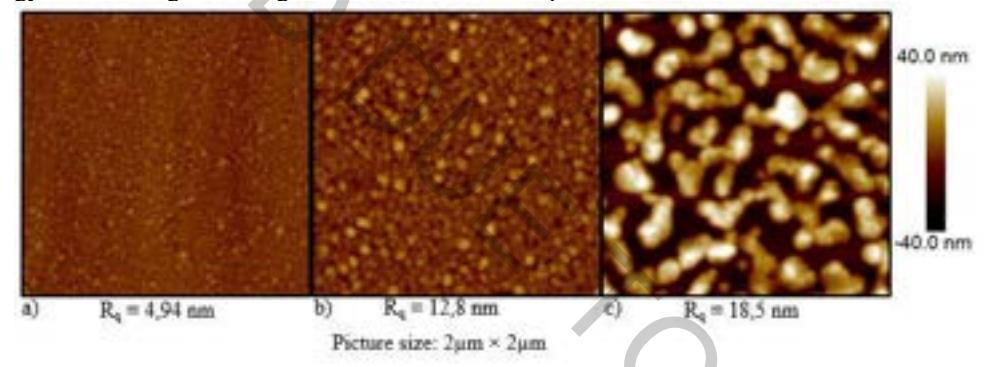
From Fig. 1 it can be seen that geometry of island-like nanoparticles changes drastically while increasing deposited amount of silver. Nanoparticles grow in size until they start to coalesce into long chain islands. Varied vacuum conditions and temperature show different influence on islands formation tendencies. More of these results will be presented at the poster session.
In summary, investigation results present the possibility to control the properties of LSPR. It shows strong dependency of LSPR on surface morphology. By varying deposition parameters absorption peak can be tuned from 400 nm to 600 nm.