Femtosecond (fs) lasers are becoming a preferred tool in transparent media processing due to the possibility to induce highly localized and well-defined modification on the surface or in the volume of the material [1]. It was proven to be suitable to produce components or whole functional devices out of crystals, ceramics, glasses, polymers or working directly with living organisms in the whole meso-scale. With such versatility and capabilities there is a huge drive to transfer current know-how from experimental laboratories to industry [2].
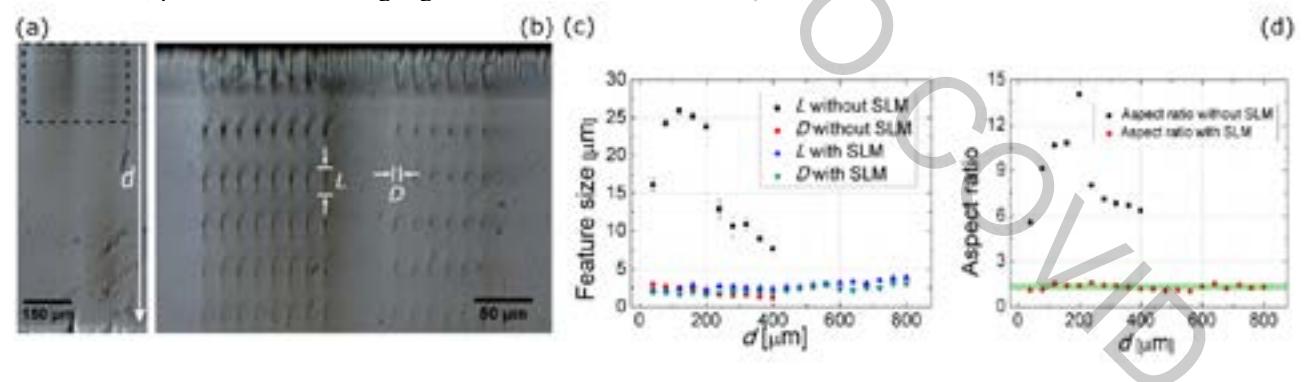
Aberrations and associated optical distortions are one of the key issues hindering the structuring quality in high definition direct laser writing. The most troublesome being spherical aberrations. These aberrations distort the voxel shape and aspect ratio depending on the focusing depth, making structuring deep inside transparent medium challenging. The problem lies in voxel elongation and subsequent energy density decrease. This limit direct laser fabrication in terms of how deep high-precision fabrication can be carried out in the volume of transparent mediums while still maintaining acceptable and controllable writing resolution. Because spherical aberrations increase the larger the refractive index difference between the specimen and the surrounding medium it is more pronounced in high refractive index (n=2.4) materials, such as diamonds, or crystals with optical anisotropy (like LinBO3) [3,4]. In glass or polymer samples it is possible to compensate for refractive index mismatch by using immersion oils that have similar refractive index values, whereas for diamond – no such oils exist. Some objectives have correction collars that can be tuned for certain depths, but their tuning range is very limited, and tuning speed is slow. Therefore, more dynamic and broad range solutions are required for tackling these optical aberrations.
In this work, we demonstrate how a spatial light modulator (SLM) can be used to minimize aberrations when fabricating single lines in transparent medium – soda lime glass. Phase mask calculation method based on Zernike polynomials is applied. An iterative algorithm for determining the exact phase mask is discussed in detail, showing which types of aberrations (spherical, defocusing, coma) have to be accounted for and to what extent. Aberration correction is demonstrated for 100x 0.9 NA objective in sample depths up to 1 mm. We show that a combination of SLM and Zernike polynomial calculation method allows to achieve nearly spherical few μm sized voxels written in arbitrary depths of glass with a femtosecond laser. Results are shown in a broader sense, highlighting how it can influence such research areas as integrated photonics or microfluidics. Possible future challenges of using SLM for aberration control, such as limited refresh rate of most SLMs (up to 60 kHz) or relatively large pixel sizes (up to 20 μm) are discussed, possible solutions highlighted.