The first Linear accelerator (LINAC) for cancer treatment was firstly applied in Hammersmith Hospital (London, UK), in 1953 [1], which operated with the 8 MeV electron beam energy. Electrons in LINAC are usually generated by a Pierce-type electron gun [2]. In modern LINACs different electron beam energies can be generated depending on equipment provider. For example, Varian linear accelerators currently offer selected electron beams of 4, 6, 9, 12, 16, and 20 MeV energies [3]. For the safe performance it is important to know the distribution of electron/photon beams and their interaction with matter process.
In this work, the interaction processes induced by electrons, when energies are 9, 16 and 20 MeV were studied. Attention is also drawn to the resulting photons and their interaction processes. In general, particle transport calculations of electron are fundamentally different from photons. Neutral particle interactions are characterized by relatively uncommon collisions and long mean free path, while electrons interaction with matter is supported by the Coulomb laws. For example: When photon or electron interacts with an aluminium plate. In case, when energy is decreasing from 0.5 MeV to 0.0625 MeV, photons will have less than 10 interactions, while electrons have more than $10^5$ [4].
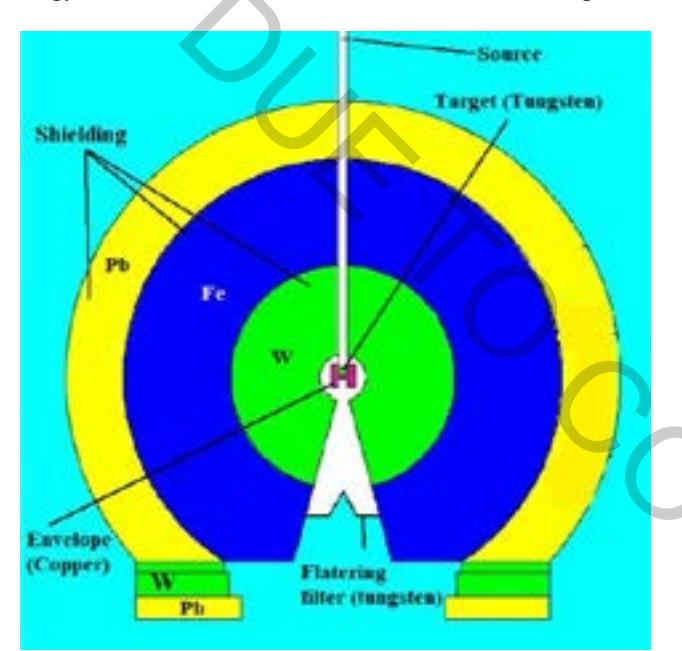
This work presents the pilot model of medical linear accelerator treatment head, which was created using MCNP-VIS (see figure 1) and particle transport calculations were performed with $10^6$ particles. Calculations have shown that increasing energy secondary electron generation is by electrons is reduced, however improved for photons. The number of reactions for both photons and electrons increased by the factor of 1.2 and the average energy of the reactions increased by 10 MeV and 26 MeV respectively. In addition, dose rate calculations were also performed and results shown that increase of electron energy from 9 to 20 MeV was able for dose rate changes from 0.54 Sv/h to 0.89 Sv/h.