Ultrasound is essential for biological research to create targeted mutations in plant breeding, to break cell membranes and destroy intracellular structures [1]. Ultrasound is commonly used for a therapy and a diagnosis in medicine.
Compact ultrasonic emitters are necessary today. In this article, such emitters are designed. A compact ultrasonic emitter consists of an optical fiber and a layer of nanoparticles deposited on its edge. Emitter under study is characterized by wide range of possible ultrasonic signals for various media, in particular for biological fluids. Compact ultrasonic emitters have benefits of compact size, low weight, high resistance to electromagnetic interference, mechanical flexibility and high chemical resistance.
The ultrasound emission is based on surface plasmon resonance effect. Modulated laser signal passes through optical fiber and it is absorbed by metal nanoparticles at the fiber edge. Due to thermal expansion, nanoparticle re-radiates mechanical oscillations [2]. Results of optical properties computer modelling are presented in this article for nanostructures with metal nanoparticles at the optical fiber edge fiber in various media such as air, water and biological fluids (including blood). The purpose of the work is to find the optimal parameters for the compact ultrasound emitter to increase the efficiency of ultrasound generation. The absorption of modulated optical signal by nanoparticles should be maximazed [3]. Hence, nanoparticles radii and the media should be chosen according to the condition above. The simulation was performed with the MiePlot package for gold and silver nanoparticles with radii from 5 nm to 50 nm and medium with a refractive index ranging from 1.2 to 1.6.
To provide quick simulation, an effective refractive index for both media and substrate (optical fiber) is used. The effective refractive index is equal to arithmetic average of the refractive index of the media and substrate. This approach allows to perform express diagnostics of optical spectra.
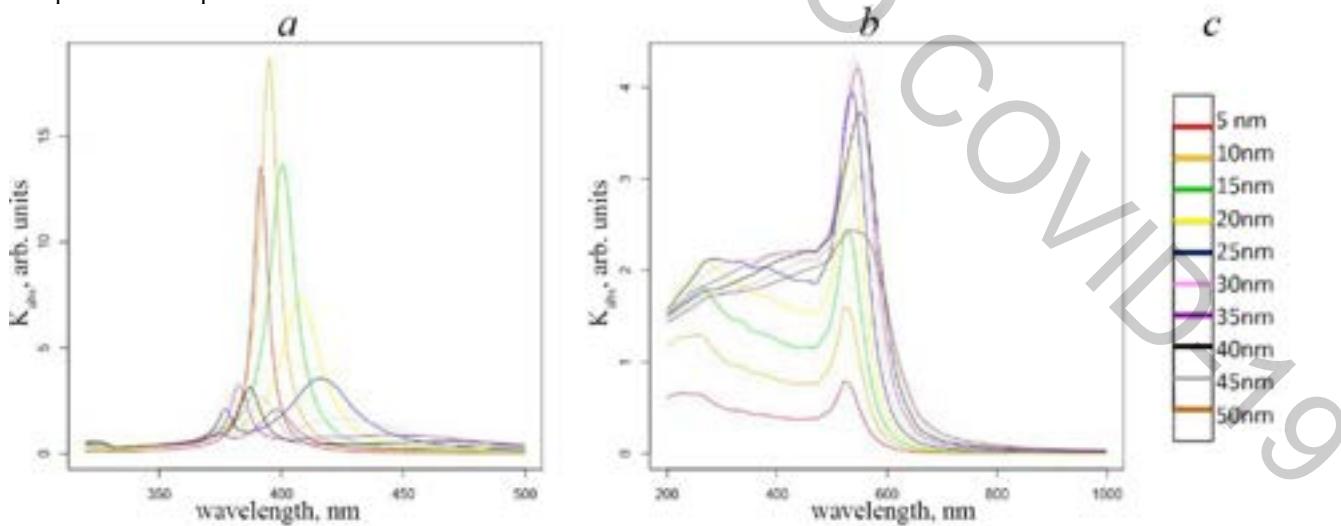
Therefore, the absorption coefficient is maximum for silver nanoparticles with radius of 10 nm at a wavelength of 410 nm in media with effective refractive index of $n = 1.52$. As for gold nanoparticles, the absorption maximum is reached in the same medium at wavelength of 548 nm for radius of 25 nm. In conclusion, silver nanoparticles have four times the absorption coefficient as big as the absorption coefficient in gold nanoparticles under the same conditions. It was found that increase of the refractive index of the medium leads to a rise of the maximum value of the absorption coefficient. Its peak position also shifts towards to longer wavelengths. The shift is 10 nm for nanoparticles with a radius of 50 nm compared to nanoparticles with radius of 10 nm.